 Talmud Bavli
Shabbat 113b : Youtube
Daf TubeYoutube
2 video classes :
Shabbat Page 113b
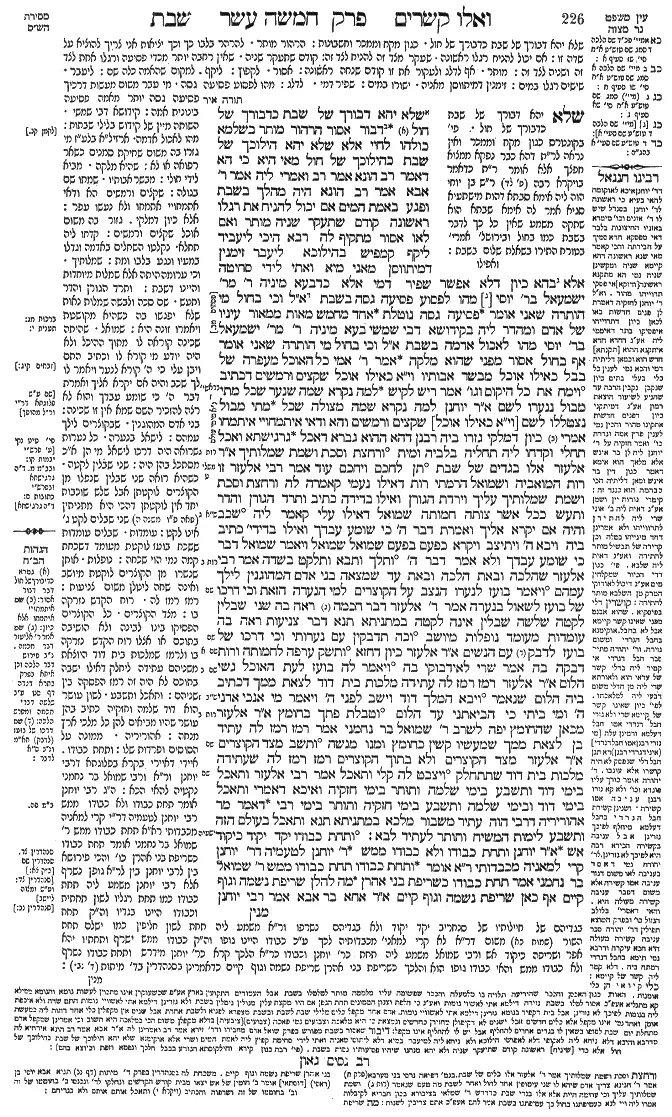
Shabbat 113b - Guemara
שלא יהא דבורך של שבת כדבורך של חול דבור אסור הרהור מותר בשלמא כולהו לחיי אלא שלא יהא הילוכך של שבת כהילוכך של חול מאי היא כי הא דאמר רב הונא אמר רב ואמרי ליה אמר ר' אבא אמר רב הונא היה מהלך בשבת ופגע באמת המים אם יכול להניח את רגלו ראשונה קודם שתעקר שניה מותר ואם לאו אסור מתקיף לה רבא היכי ליעביד ליקף קמפיש בהילוכא ליעבר זימנין דמיתווסן מאני מיא ואתי לידי סחיטה אלא בהא כיון דלא אפשר שפיר דמי אלא כדבעא מיניה ר' מר' ישמעאל בר' יוסי מהו לפסוע פסיעה גסה בשבת א"ל וכי בחול מי הותרה שאני אומר פסיעה גסה נוטלת אחד מחמש מאות ממאור עיניו של אדם ומהדר ליה בקידושא דבי שמשי בעא מיניה ר' מר' ישמעאל בר' יוסי מהו לאכול אדמה בשבת א"ל וכי בחול מי הותרה שאני אומר אף בחול אסור מפני שהוא מלקה אמר ר' אמי כל האוכל מעפרה של בבל כאילו אוכל מבשר אבותיו וי"א כאילו אוכל שקצים ורמשים דכתיב (בראשית ז, כג) וימח את כל היקום וגו' אמר ריש לקיש למה נקרא שמה שנער שכל מתי מבול ננערו לשם א"ר יוחנן למה נקרא שמה מצולה שכל מתי מבול נצטללו לשם [וי"א כאילו אוכל] שקצים ורמשים והא ודאי איתמחויי איתמחו אמרי כיון דמלקי גזרו ביה רבנן דהא ההוא גברא דאכל גרגישתא ואכל תחלי וקדחו ליה תחליה בלביה ומית (רות ג, ג) ורחצת וסכת ושמת שמלותיך א"ר אלעזר אלו בגדים של שבת (משלי ט, ט) תן לחכם ויחכם עוד אמר רבי אלעזר זו רות המואביה ושמואל הרמתי רות דאילו נעמי קאמרה לה ורחצת וסכת ושמת שמלותיך עליך וירדת הגורן ואילו בדידה כתיב ותרד הגורן והדר ותעש ככל אשר צותה חמותה שמואל דאילו עלי קאמר ליה (שמואל א ג, ט) שכב והיה אם יקרא אליך ואמרת דבר ה' כי שומע עבדך ואילו בדידי' כתיב ביה ויבא ה' ויתיצב ויקרא כפעם בפעם שמואל שמואל ויאמר שמואל דבר כי שומע עבדך ולא אמר דבר ה' (רות ב, ג) ותלך ותבא ותלקט בשדה אמר רבי אלעזר שהלכה ובאת הלכה ובאת עד שמצאה בני אדם המהוגנין לילך עמהם (רות ב, ה) ויאמר בועז לנערו הנצב על הקוצרים למי הנערה הזאת וכי דרכו של בועז לשאול בנערה אמר ר' אלעזר דבר חכמה ראה בה שני שבלין לקטה שלשה שבלין אינה לקטה במתניתא תנא דבר צניעות ראה בה עומדות מעומד נופלות מיושב (רות ב, ח) וכה תדבקין עם נערותי וכי דרכו של בועז לדבק עם הנשים א"ר אלעזר כיון דחזא (רות א, יד) ותשק ערפה לחמותה ורות דבקה בה אמר שרי לאידבוקי בה (רות ב, יד) ויאמר לה בועז לעת האוכל גשי הלום א"ר אלעזר רמז רמז לה עתידה מלכות בית דוד לצאת ממך דכתיב ביה הלום שנאמר (שמואל ב ז, יח) ויבא המלך דוד וישב לפני ה' ויאמר מי אנכי אדני ה' ומי ביתי כי הביאתני עד הלום (רות ב, יד) וטבלת פתך בחומץ א"ר אלעזר מכאן שהחומץ יפה לשרב ר' שמואל בר נחמני אמר רמז רמז לה עתיד בן לצאת ממך שמעשיו קשין כחומץ ומנו מנשה (רות ב, יד) ותשב מצד הקוצרים א"ר אלעזר מצד הקוצרים ולא בתוך הקוצרים רמז רמז לה שעתידה מלכות בית דוד שתתחלק (רות ב, יד) ויצבט לה קלי ותאכל אמר רבי אלעזר ותאכל בימי דוד ותשבע בימי שלמה ותותר בימי חזקיה ואיכא דאמרי ותאכל בימי דוד ובימי שלמה ותשבע בימי חזקיה ותותר בימי רבי דאמר מר אהוריריה דרבי הוה עתיר משבור מלכא במתניתא תנא ותאכל בעולם הזה ותשבע לימות המשיח ותותר לעתיד לבא:
(ישעיהו י, טז) ותחת כבודו יקד יקוד כיקוד אש א"ר יוחנן ותחת כבודו ולא כבודו ממש ר' יוחנן לטעמיה דר' יוחנן קרי למאניה מכבדותי ר"א אומר ותחת כבודו תחת כבודו ממש ר' שמואל בר נחמני אמר תחת כבודו כשריפת בני אהרן מה להלן שריפת נשמה וגוף קיים אף כאן שריפת נשמה וגוף קיים א"ר אחא בר אבא אמר רבי יוחנן
Comments from Rashi on Masechet Shabbat Page 113b
שלא יהא דבורך של שבת כדבורך של חול . כגון מקח וממכר וחשבונות: הרהור מותר . להרהר בלבו כך וכך יציאות אני צריך להוציא על שדה זו: אם יכול להניח רגלו ראשונה . שעקר מצד זה להניח לצד זה: קודם שתעקר שניה . שאין רחבה יותר מכדי פסיעה ורגלו אחת לצד זה ושניה לצד זה: מותר . אף לדלג ולעקור את זו קודם שנחה ראשונה: אסור . לקפוץ: ליקף . למקום שהאמה כלה שם: ליעבר . שישים רגלו במים: זימנין דמיתווסן מאניה . ישורו במים: שפיר דמי . לדלג: מהו לפסוע פסיעה גסה . מי עבר משום מעשות דרכיך פסיעה גסה יותר מאמה פסיעה בינונית אמה: קידושא דבי שמשי . השותה מיין של קידוש בלילי שבתות: מהו לאכול אדמה . ארזיל"א בלע"ז מי גזרו בה משום שחיקת סמנים כשאר רפואה או לא: שהיא מלקה . מביא לידי חולי: מבשר אבותיו . שמתו שם בגולה: שקצים ורמשים הא ודאי אתמחוי אתמחו ולא נעשו עפר: אלא כיון דמלקי . גזור בה משום אוכל שקצים ורמשים: קדחו ליה תחלא . נקלטו השחלים באדמה וגדלו במעיו ונגע בלבו ומת: שמלותיך . וכי ערומה היתה אלא שמלות מיוחדות והיינו דשבת: ותרד הגורן והדר ותעש . שם סכה ולבשה שמלות נאות שלא יפגשו בה כשהיא מקושטת ויאמרו זונה היא: שמואל . שהיתה שכינה קוראה לו מתוך ההיכל ולא היה יודע מי קורא לו וכתיב התם ויבן עלי כי ה' קורא לנער ויאמר לו לך שכב והיה אם יקרא אליך ואמרת דבר ה' כי שומע עבדך והוא לא רצה להזכיר השם שמא אין זו שכינה: בני אדם המהוגנין . שבקוצרים לילך עמהם: לישאל בנערה . כל נערות שרואה היה דרכו לישאל מי הן א"כ מסתכל בהן היה: שני שבלין לקטה . כשהיא רואה שני שבלין שנפלו מן הקוצרים לוקטתן אבל שלש שוכבות יחד אין לוקטתן דהכי היא מתניתין (פאה פ"ו משנה ה) שני שבלים לקט ג' אינו לקט: עומדות . שבלים עומדות ששכח בועז לוקטת מעומד דשכחת קמה נמי הוי שכחה: נופלות . אותן שנשרו מן הקוצרים לוקטת מיושב ואינה שחה ליטלן משום צניעות: רמז רמז לה . רוח הקדש נזרקה בו: מצד הקוצרים . כל הקוצרים הפסיקו בינו לבינה ולא הושיבה בתוכם או אצלו רוח הקדש נזרקה בו ולרמז שמלכות בית דוד היוצאת משניהם עתידה ליחלק דאילו ישבה בתוכם לא היה זה רמז הפסקה בין שניהם: ותאכל ותשבע . לשון עושר הוא דוד שלמה וחזקיה כתיב בהן עושר שהיו מביאים להן כל מלכי ארץ מנחה: אהוריריה . ממונה על הסוסים ופרדות שלו: ותחת כבודו . איידי דאיירי בקרא בפלוגתא דרבי יוחנן ור"א ורבי שמואל בר נחמני נקטיה להאי הכא: ה"ג רבי יוחנן אומר תחת כבודו ולא כבודו ממש רבי יוחנן לטעמיה דר"י קרי למאניה מכבדותי רא"א תחת כבודו ממש ר' שמואל בר נחמני אומר תחת כבודו כשריפת בני אהרן כו' . והכי פירושא בין לרבי יוחנן בין לר"א גופן נשרף אלא רבי יוחנן משמע ליה תחת כבודו כמו תחת רגליו לשון תחתית וכבודו היינו בגדיו וה"ק תחת בגדיהם של חיילותיו של סנחריב יקד יקוד ולא בגדיהם נשרפו ור"א משמע ליה תחת לשון חליפין כמו ישלם תחת השור (שמות כא) משום דר"א לא קרי למאני' מכבדותיה לכך ע"כ כבודו היינו גופו וה"ק כבודו ממש ישרף ותחתיו יהא אפר ושריפה כיקוד אש ורבי שמואל משמע ליה תחת כר' יוחנן וכבודו כר"א הלכך קרא כר' יוחנן מידרש ותחת כבודו נשרף ולא כבודו ממש והאי כבודו גופו הוא והלכך כשריפת בני אהרן שריפת נשמה וגוף קיים כדאמרינן בסנהדרין בד' מיתות (ד' נב.):
Comments from Tosafot - Shabbat 113b
שלא יהא דבורך של שבת כדבורך של חול . פי' בקונטרס כגון מקח וממכר ואין נראה לר"ת דהא כבר נפקא ממצוא חפצך אלא אומר ר"ת כדאמר בויקרא רבה (פ' לד) ר"ש בן יוחי הוה ליה אימא סבתא דהות מישתעיא סגיא אמר לה אימא שבתא הוא שתקה משמע שאין כל כך לדבר בשבת כמו בחול ובירושל' אמרי' בטורח התירו בשאלת שלום בשבת:
Shabbat 113b - Mishnah translated into english
means that your speech on Shabbat should not be like your speech during the week, i.e., one should not discuss his weekday affairs on Shabbat. However, it is only speech that they said is prohibited, whereas merely contemplating weekday affairs is permitted. The Gemara asks: Granted, all of these directives, fine, they are understood. However, what is the meaning of the following phrase: That your walking on Shabbat should not be like your walking during the week? The Gemara answers: It is in accordance with that which Rav Huna said that Rav said, and some say that Rabbi Abba said that Rav Huna said: If one were walking on Shabbat and came upon a stream of water and had to cross it, if the stream is narrow and one could place his first foot down on the other side before raising the second one, it is permitted to cross it; and if it is not possible and one must jump to cross it, it is prohibited. That is the type of walking that is not permitted on Shabbat.
Rava strongly objects to this: Since we have said that one’s walking on Shabbat should not be like his walking during the week, and jumping constitutes prohibited walking, if one encounters a stream on Shabbat, what should he do to cross to the other side? If he circumvents the stream, he is increasing the distance that he is walking and exerting extra effort on Shabbat. If he walks through the water, sometimes his clothes will absorb water and he will come to wring them out. What then should he do? Rather, in this case, since it is not possible to cross any other way, he may well cross it, i.e., it is permitted for him to jump over the stream. Therefore, rather say that walking that is defined as characteristic of weekday walking involves taking large steps. As Rabbi Yehuda HaNasi raised a dilemma before Rabbi Yishmael, son of Rabbi Yosei: What is the ruling with regard to taking large steps on Shabbat? That is what the Gemara meant when it used the phrase: Your walking during the week. Rabbi Yishmael said to him: And during the week are large steps permitted? As I say: A large step takes away one five-hundredth of a person’s eyesight. The Gemara comments: And his eyesight is restored to him during kiddush on Shabbat evening.
And Rabbi Yehuda HaNasi raised a dilemma before Rabbi Yishmael, son of Rabbi Yosei: What is the ruling with regard to eating earth for medicinal purposes on Shabbat? Rabbi Yishmael said to him: And during the week is it permitted to eat soil? As I say: Even during the week it is prohibited because it is harmful. Rabbi Ami said: Anyone who eats the dust of Babylonia, it is as if he is eating the flesh of his ancestors buried there. And some say: It is as if he eats abominations and creeping creatures, as it is written: “And He wiped out all that existed on the face of the earth, from humans to animals, to creeping creatures to the birds in the sky, and they were wiped off the land” (Genesis 7:23).
Apropos dead residue in the ground, Reish Lakish said: Why is Babylonia called Shinar? It is because all those who died in the Flood were deposited there [ninaru lesham]. Rabbi Yoḥanan said: Why is Babylonia called Metzula? It is because all those who died in the Flood sank there [nitztalelu lesham]. The Gemara asks: We said that some say that if one eats dirt from Babylonia, it is as if he eats abominations and creeping creatures. However, certainly their bodies have putrefied and decomposed, and therefore they are no longer prohibited. Rather, since soil is harmful, the Sages issued a decree not to eat it. The decree was not issued due to the prohibition of eating creeping creatures; rather, it was issued because a certain person ate soil for medicinal purposes and also ate cress. The cress took root in the soil that was inside him and began to grow. And the cress punctured his heart and he died.
The Gemara continues to discuss Shabbat. Naomi advised Ruth: “And you shall bathe, and anoint yourself, and put on your robes, and go down to the threshing floor. Do not make yourself known to the man until he has finished eating and drinking” (Ruth 3:3). Rabbi Elazar said: These robes are Shabbat garments that Naomi told her to wear in honor of the occasion. Apropos the book of Ruth, the Gemara cites additional statements of Rabbi Elazar with regard to Ruth: “Give to the wise one and he will become wiser; let the righteous one know and he will learn more” (Proverbs 9:9). Rabbi Elazar said: This refers to Ruth the Moabite and Samuel of Rama, who received advice and added to it with their wisdom.
The Gemara elaborates. Whereas Naomi said to Ruth: “And you shall bathe, and anoint yourself, and put on your robes, and go down to the threshing floor,” but with regard to Ruth herself it is written, “And she went down to the threshing floor” (Ruth 3:6), and only afterward does it say, “And she did according to all that her mother-in-law commanded her.” Ruth decided to anoint herself at the threshing floor and not on the road so that people would not meet her on the way there and suspect her of immorality. Whereas Eli said to Samuel: “Go and lie down and if He calls you, you say: Speak, Lord, for Your servant is listening” (I Samuel 3:9), but with regard to Samuel himself it is written: “And the Lord came and stood, and He called like He did the other times: Samuel, Samuel. And Samuel said: Speak, for Your servant is listening” (I Samuel 3:10), and he did not say: Speak, Lord, since he would not assume it was God speaking to him until he was sure of it.
And the verse in Ruth states: “And she went, and she came, and she collected in the field after the harvesters” (Ruth 2:3). Rabbi Elazar said: This verse teaches that she went and came, went and came, until she found suitable people with whom to walk. It also says: “And Boaz said to his youth who was standing over the harvesters: To whom does this young woman belong?” (Ruth 2:5). This is surprising: And was it Boaz’s habit to inquire about a young woman? Rabbi Elazar said: He saw in her a matter of wisdom and Torah, and that is why he asked about her. What he saw was that she collected two stalks, but she did not collect three stalks. She thereby acted in accordance with the halakha that three stalks lying together are not considered to be gleanings left for the poor; rather, they remain in the possession of the owner of the field.
It was taught in a baraita: He saw a matter of modesty in her when she was collecting stalks. She picked stalks that were upright while she was standing, and stalks that had fallen she picked while sitting; due to her modesty she did not bend over to take them. It also says: “And Boaz said to Ruth: Do you hear, my daughter? Do not go to glean in another field and do not leave from here, but cling to my maidens” (Ruth 2:8). This is also surprising. And was it Boaz’s habit to cling to women? Rabbi Elazar said: Since he saw “And Orpah kissed her mother-in-law and Ruth clung to her” (Ruth 1:14), he said: It is permitted to cling to a woman like this.
It also says: “And Boaz said to her at mealtime: Come here [halom] and eat from the bread and dip your bread in vinegar. And she sat beside the harvesters and he gave her roasted grain and she ate, and she was satiated, and she left some over” (Ruth 2:14). Rabbi Elazar interpreted this and said that he hinted to her prophetically: In the future the kingdom of David will come from you, as it is written with regard to it, i.e., the kingdom of David: “Here,” as it is stated: “And King David came and sat before God and said: Who am I, Lord, God, and who is my family that You have brought me to here [halom]?” (II Samuel 7:18). With regard to his saying: “And dip your bread in vinegar” (Ruth 2:14), Rabbi Elazar said: From here we see that vinegar is good to have in hot weather.
Rabbi Shmuel bar Naḥmani said that he hinted to her: A son will come from you in the future whose actions will be as sharp as vinegar, and who is he? King Manasseh. “And she sat beside the harvesters.” Rabbi Elazar said with regard to this: Beside the harvesters, and not among the harvesters. He hinted to her that the kingdom of David will be divided in the future and her children will not always be in the center of Israel.
It also says in the verse: “And he gave her roasted grain and she ate, and she was satiated, and she left some over.” The Gemara explains: “And he gave her roasted grain and she ate”; this is also interpreted as a prophetic message. Rabbi Elazar said: “And she ate” was fulfilled by her children’s children in the days of David; “And she was satiated” was fulfilled in the days of Solomon; “And she left some over” was fulfilled in the days of Hezekiah. And some say that there is a different interpretation: “And she ate,” was fulfilled in the days of David and Solomon; “And she was satiated,” was fulfilled in the days of Hezekiah; “And she left some over” was fulfilled in the days of Rabbi Yehuda HaNasi. As the Master said: Rabbi Yehuda HaNasi’s horsekeeper [ahuriyarei] was richer than the king of Persia. It was taught in a baraita: “And she ate,” in this world; “and she was satiated,” in the days of the Messiah; “and she left some over,” in the future, at the end of days.
It was mentioned earlier that Rabbi Yoḥanan called his clothing his honor. The Gemara cites the interpretation of the verse that speaks about the downfall of the king of Assyria: “Therefore, the Lord, the Lord of hosts, will send leanness to his fat ones and under his honor He will burn a burning like a burning fire” (Isaiah 10:16).
Rabbi Yoḥanan said: “And under his honor,” but not his actual honor. The Gemara explains: Rabbi Yoḥanan follows his own reasoning, for he called his clothing my honor, which means that the bodies of the king of Assyria’s soldiers were burned. However, their garments were miraculously not burned.
Rabbi Elazar said: “And under his honor” means in place of his actual honor. That is to say, their bodies were burned. Since, in Rabbi Elazar’s opinion, the word under means in the place of, the verse accordingly means that in the place of his honor, i.e., the body, there remain ashes.
Rabbi Shmuel bar Naḥmani said: Under his honor means beneath his flesh, similar to the burning of the sons of Aaron. Just as there, i.e., the burning of Aaron’s sons, the soul burned while the body remained intact, so too here, i.e., the burning of Assyrian soldiers, the soul burned while the body remained intact.
Rabbi Aḥa bar Abba said that Rabbi Yoḥanan said:
Traduction : The William Davidson digital edition of the Koren Noé Talmud, with commentary by Rabbi Adin Even-Israel Steinsaltz.