 Talmud Bavli
Mo'ed Katan 9b : Youtube
Daf TubeYoutube
3 video classes :
Mo'ed Katan Page 9b
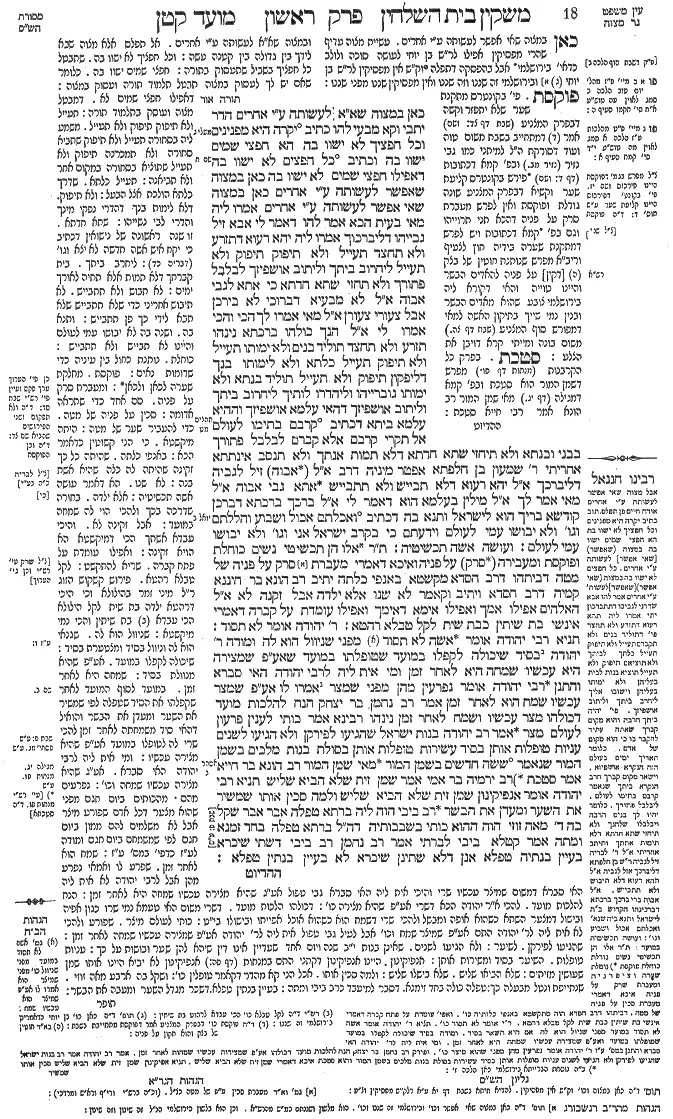
Mo'ed Katan 9b - Guemara
כאן במצוה שא"א לעשותה ע"י אחרים הדר יתבי וקא מבעי להו כתיב (משלי ג, טו) יקרה היא מפנינים וכל חפציך לא ישוו בה הא חפצי שמים ישוו בה וכתיב (משלי ח, יא) כל חפצים לא ישוו בה דאפילו חפצי שמים לא ישוו בה כאן במצוה שאפשר לעשותה ע"י אחרים כאן במצוה שאי אפשר לעשותה ע"י אחרים אמרו ליה מאי בעית הכא אמר להו דאמר לי אבא זיל גבייהו דליברכוך אמרו ליה יהא רעוא דתזרע ולא תחצד תעייל ולא תיפוק תיפוק ולא תעייל ליחרוב ביתך וליתוב אושפיזך לבלבל פתורך ולא תחזי שתא חדתא כי אתא לגבי אבוה א"ל לא מבעיא דברוכי לא בירכן אבל צעורי צעורן א"ל מאי אמרו לך הכי והכי אמרו לי א"ל הנך כולהו ברכתא נינהו תזרע ולא תחצד תוליד בנים ולא ימותו תעייל ולא תיפוק תעייל כלתא ולא לימותו בנך דליפקון תיפוק ולא תעייל תוליד בנתא ולא ימותו גוברייהו וליהדרו לותיך ליחרוב ביתך וליתוב אושפיזך דהאי עלמא אושפיזך וההיא עלמא ביתא דכתיב (תהלים מט, יב) קרבם בתימו לעולם אל תקרי קרבם אלא קברם לבלבל פתורך בבני ובנתא ולא תיחזי שתא חדתא דלא תמות אנתך ולא תנסב אינתתא אחריתי ר' שמעון בן חלפתא אפטר מיניה דרב א"ל (אבוה) זיל לגביה דליברכך א"ל יהא רעוא דלא תבייש ולא תתבייש אתא גבי אבוה א"ל מאי אמר לך א"ל מילין בעלמא הוא דאמר לי א"ל ברכך ברכתא דברכן קודשא בריך הוא לישראל ותנא בה דכתיב (יואל ב, כו) ואכלתם אכול ושבוע והללתם וגו' ולא יבושו עמי לעולם וידעתם כי בקרב ישראל אני וגו' ולא יבושו עמי לעולם:
ועושה אשה תכשיטיה:
ת"ר אלו הן תכשיטי נשים כוחלת ופוקסת ומעבירה (סרק) על פניה ואיכא דאמרי מעברת סרק על פניה של מטה דביתהו דרב חסדא מקשטא באנפי כלתה יתיב רב הונא בר חיננא קמיה דרב חסדא ויתיב וקאמר לא שנו אלא ילדה אבל זקנה לא א"ל האלהים אפילו אמך ואפילו אימא דאימך ואפילו עומדת על קברה דאמרי אינשי בת שיתין כבת שית לקל טבלא רהטא:
ר' יהודה אומר לא תסוד:
תניא רבי יהודה אומר אשה לא תסוד מפני שניוול הוא לה ומודה ר' יהודה בסיד שיכולה לקפלו במועד שטופלתו במועד שאע"פ שמצירה היא עכשיו שמחה היא לאחר זמן ומי אית ליה לרבי יהודה האי סברא והתנן רבי יהודה אומר נפרעין מהן מפני שמצר אמרו לו אע"פ שמצר עכשיו שמח הוא לאחר זמן אמר רב נחמן בר יצחק הנח להלכות מועד דכולהו מצר עכשיו ושמח לאחר זמן נינהו רבינא אמר כותי לענין פרעון לעולם מצר אמר רב יהודה בנות ישראל שהגיעו לפירקן ולא הגיעו לשנים עניות טופלות אותן בסיד עשירות טופלות אותן בסולת בנות מלכים בשמן המור שנאמר (אסתר ב, יב) ששה חדשים בשמן המור מאי שמן המור רב הונא בר חייא אמר סטכת רב ירמיה בר אמי אמר שמן זית שלא הביא שליש תניא רבי יהודה אומר אנפיקינון שמן זית שלא הביא שליש ולמה סכין אותו שמשיר את השער ומעדן את הבשר רב ביבי הוה ליה ברתא טפלה אבר אבר שקל בה ד' מאה זוזי הוה ההוא כותי בשבבותיה דה"ל ברתא טפלה בחד זמנא ומתה אמר קטלא ביבי לברתי אמר רב נחמן רב ביבי דשתי שיכרא בעיין בנתיה טפלא אנן דלא שתינן שיכרא לא בעיין בנתין טפלא:
Comments from Rashi on Masechet Mo'ed Katan Page 9b
ובמצוה שא"א לעשותה ע"י אחרים . אל תפלס אלא מצוה שבא לידך בין גדולה בין קטנה עשה: וכל חפציך לא ישוו בה . שתבטל כל חפציך בשביל שתעסוק בתורה: חפצי שמים ישוו בה . כלומר שאם יש לך לעסוק במצוה תבטל תלמוד תורה ועסוק במצוה: דאפילו חפצי שמים לא . דמבטל מצוה ועוסק בתלמוד תורה: תעייל ולא תיפוק תיפוק ולא תעייל . משמע ליה בסחורה תעייל ולא תיפוק שתביא סחורה ולא תמכרנה תיפוק ולא תעייל שתוציא בסחורה במקום אחר ולא תביאנה: תעייל כלתא . שדרך כלתא הולכת אצל הבעל: ולא תיפוק . דלא לימות בנך דהדרי נפקי מינך והדרי לבי נשייהו: שתא חדתא . זו שנה ראשונה של נישואין דכתיב כי יקח איש אשה חדשה לא יצא וגו' (דברים כד): ליחרב ביתך . בית קברתך דלא תמות אלא תחיה לאורך ימים: לא תבוש ולא תתבייש . לא תיבוש אחריני כדי שלא תתבייש שלא תבא לידי כך פן תתבייש: ותנא בה . ושנה בה לא יבושו עמי לעולם והיינו לא תבייש ולא תתבייש: כוחלת . נותנת כחול בין עיניה כדי שדומות נאים: פוקסת . מחלקת שערה לכאן ולכאן: ומעברת סרק על פניה . סם אחד כדי שתראה אדומה: סכין על פניה של מטה . כדי להעביר שער של מטה: היתה מיקשטא . כי הני קשוטין כדאמר הכא: באנפי כלתה . שהיתה כל כך זקינה שהיתה לה כלה שהיא אשת בנה: לא שנו . הא דאמר עושה אשה תכשיטיה: אלא ילדה . בחורה שדרכה בכך ולהכי הוי לה שמחה במועד: אבל זקינה לא . והיכי עבדא אשתך הכי דמיקשטא הא הויא זקינה: ואפילו עומדת על פתח קברה . שריא להתקשט: לקל טבלא רהטא . פירוש קשקוש הזוג ר"ל מיני זמר בהילולא וכי היכי דרהטא ילדה בת שית לקל הילולא הכי עבדא בת שיתין והכי נמי מיקשטא: שניוול הוא לה . שגנאי הוא לה וניוול בסיד ומצטערת בסיד: שיכולה לקפלו במועד . אע"פ שהיא מנוולת בסיד: שמחה היא לאחר זמן . במועד לסוף המועד לאחר שקפלתו את הסיד שטפלה לפי שמשיר את השער ומעדן את הבשר והואיל דהאי סיד משמחתה לאחר זמן להכי שרי לה לטופלו במועד אע"פ שהיא מצירה עכשיו: ומי אית ליה לרבי יהודה האי סברא . אע"ג שהיא מצירה עכשיו שמחה וכו': נפרעים מהם . מהכותים ביום חגם מפני שהוא מצער דכל אדם שפורע מיצר אבל לא משלמים להם ממון ביום חגם לפי שמשמחם ביום חגם ומודה לע"ז כדפי' במס' ע"ז: שמח הוא לאחר זמן . שפרע לו ואמאי נפרע מהן אבל לרבי יהודה לא אית ליה האי סברא דמשום שמיצר עכשיו שרי והיכי אית ליה האי סברא גבי טפול אע"ג שהיא מצירה עכשיו שמחה היא לאחר זמן: הנח להלכות מועד . להכי א"ר יהודה הכא דשרי אע"פ שהיא מצירה כו': דכולהו הלכות מועד . דשרי משום האי טעמא נמי שרו כגון אפיה ובישול דמצער השתא כשהוא אופה ומבשל ולהכי שרי דשמח הוא כשהוא אוכל אפייתו ובישולו ביו"ט: כותי לעולם מיצר . שפורע ולהכי לא אית ליה לר' יהודה התם אע"פ שמיצר שמח וכו' אבל לעיל גבי טפול אית ליה לר' יהודה אע"פ שמצירה עכשיו שמחה לאחר זמן: שהגיעו לפירקן . לשיער: ולא הגיעו לשנים . שאינן בנות י"ב שנה ויום אחד שעדיין אינו דין שיהא להן שער ובושות על כך: עניות טופלות . השיער בסיד ומשירות אותן: אנפיקינון . היינו אנפיקינון דקתני התם במנחות (דף פה:) אנפיקינון לא יביא היינו אותו שמן שעושין מזיתים: שלא הביאו שליש . שלא בישלו שליש: ולמה סכין אותו . אכל הני קא מהדר דקאמר טופלין כו': ושקל בה ארבע מאה זוזי . שנתייפת ונטל מבעלה כך: טפלה כולה בחד זימנא . דסבר למיעבד כרב ביבי ומתה: בעיין בנתין טפלא . דשכר מגדל השער ומעבה את הבשר:
Comments from Tosafot - Mo'ed Katan 9b
כאן במצוה שאי אפשר לעשותה ע"י אחרים. עשיית מצוה עדיף שהרי מפסיקין אפילו לר"ש בן יוחי לעושה סוכה ולולב כדאי' בירושלמי. אבל בהפסקה דתפלה וק"ש אין מפסיקין לר"ש בן יוחי ובירושלמי זה שננו וזה שננו ואין מפסיקין שננו מפני שננו: פוקסת. פי' בקונטרס מתקנת שער שלא יתפזר וקשה דבפרק המצניע (שבת דף צד: ושם) אמר דמתחייב בשבת משום טוה ועוד דסורקת ה"ל למיתני כמו גבי נזיר (נזיר מב.) ובפ' קמא דכתובות (דף ד: ושם) פירש בקונטרס קליעת שער וקשיא דבפרק המצניע שונה גודלת ופוקסת ואין לפרש מעברת סרק על פניה דהכא תני תרוייהו וגם בפ'. קמא דכתובות ויש לפרש דמתקנת שערה בידיה חוץ לצעיף וריב"א מפרש שנותנת חוטין של בצק [דקין] על פניה להאדים הבשר והיינו טוייה והאי דקורא ליה בירושלמי צובע שהוא מאדים הבשר ובנין נמי שייך בתיקון האשה למאי דמפורש סוף המצניע (שבת דף צה.) משום בונה ומייתי קרא דויבן את הצלע: סטכת. בפרק כל הקרבנות (מנחות דף פו.) מפרש דשמן המור הוא סטכת ובפ' קמא. דמגילה (דף יג.) מאי שמן המור רב הונא אמר רבי חייא סטכת:
Mo'ed Katan 9b - Mishnah translated into english
There, in the other verse, it is referring to a mitzva that cannot be done by others, and therefore, one must not consider its relative importance, but rather do it immediately.
The two scholars, Rabbi Yonatan ben Asmai and Rabbi Yehuda, son of converts, once again sat and raised the following dilemma: In one place it is written in praise of the Torah: “She is more precious than rubies; and all of your desires are not to be compared to her” (Proverbs 3:15). One can infer from here that all human desires cannot be compared to the Torah, but the desires of Heaven, i.e., mitzvot, can indeed be compared to her. And elsewhere it is written: “For wisdom is better than rubies; and all the things that may be desired are not to be compared to it” (Proverbs 8:11), which indicates that even mitzvot cannot be compared to the Torah.
They resolved this contradiction by stating that here, in the second verse, it is discussing a mitzva that can be done by others. In that case, even mitzvot cannot be compared to the Torah, and accordingly, one who is engaged in Torah study should not interrupt his studies in order to perform another mitzva. However, there, in the first verse, it is discussing a mitzva that cannot be done by others. In that case Torah study is not more important than the mitzva, and one should interrupt his studies in order to perform the mitzva.
When Rabbi Yonatan ben Asmai and Rabbi Yehuda, son of converts, noticed Rabbi Shimon ben Yoḥai’s son, they said to him: What do you want here? He said to them: Father told me: Go to them so that they should bless you. They said to him as follows: May it be God’s will that you should sow and not reap, that you should bring in and not take out, that you should take out and not bring in, that your house should be destroyed and your lodging place should be inhabited, that your table should become confused, and that you should not see a new year.
When he came back to his father, he said to him: Not only did they not bless me, but they even caused me pain with their negative words. His father said to him: What exactly did they say to you? He answered: They said to me such and such. Rabbi Shimon ben Yoḥai said to his son: These are all blessings, uttered in a cryptic manner, and this is what they meant: When they said that you should sow and not reap they meant that you should bear sons and they should not die. Their statement that you should bring in and not take out means that you should bring in brides for your sons and your sons should not die, which would cause their wives to leave. When they said you should take out and not bring in they meant that you should have daughters and their husbands should not die, which would cause your daughters to return to you.
When they said that your house should be destroyed and your lodging place should be inhabited, this should be interpreted allegorically. As this world is compared to your lodging place, and the World-to-Come is compared to your house, as it is written: “Their inward thought [kirbam], is that their houses shall continue forever” (Psalms 49:12), and the Sages said: Do not read it as “their inward thought [kirbam]”; rather read it as their graves [kivram]. According to this reading, one’s grave is considered his permanent house. The Sages gave Rabbi Shimon ben Yoḥai’s son a blessing that he should dwell in his temporary home rather than his permanent home, i.e., he should live a long life.
When they said that your table should become confused, they meant that you should be blessed with many sons and daughters, so that there will be noise and confusion at your table. When they said that you should not see a new year, they meant your wife should not die and as a result you should not have to marry another woman, about which it says: “When a man has taken a new wife, he shall not go out to war, neither shall he be charged with any business; he shall be free at home for one year” (Deuteronomy 24:5).
Apropos a blessing with an obscure meaning, the Gemara relates: Rabbi Shimon ben Ḥalafta took leave of Rav. His father said to him: Go to him so that he should bless you. When Rabbi Shimon ben Ḥalafta returned to him for a blessing, Rav said to him: May it be God’s will that you should not shame others and that you should not feel ashamed. He came home to his father, who said to him: What did he say to you? He said to him: Mere words he said to me, i.e., he did not say anything of significance.
After Rabbi Shimon ben Ḥalafta repeated what Rav had said, his father said to him: He blessed you with the blessing with which the Holy One, Blessed be He, blessed Israel and then repeated the blessing, indicating that is a very great blessing, as it is written: “And you shall eat in plenty, and be satisfied, and praise the Name of the Lord your God, who has dealt wondrously with you; and My people shall never be ashamed. And you shall know that I am in the midst of Israel, and that I am the Lord your God, and there is none else; and My people shall never be ashamed” (Joel 2:26–27).
§ It was taught in the mishna: And a woman may engage in all of her usual cosmetic treatments on the intermediate days of a Festival. The Sages taught in a baraita: These are the cosmetic treatments of women that are permitted: She may paint her eyelids, she may remove unwanted hair [pokeset], and she may put rouge on her face. And some say: She may pass a comb over her lower face, i.e., she may remove the hair from her pubic area.
The Gemara relates that Rav Ḥisda’s wife would adorn herself on the intermediate days of a Festival in the presence of her daughter-in-law, i.e., when she already had a married son. Rav Huna bar Ḥinnana sat before Rav Ḥisda, and he sat and said: They taught only that a woman is permitted to engage in cosmetic treatments on the intermediate days of a Festival only with regard to a young woman, as such treatments bring her joy, but in the case of an old woman, no, the treatments are not permitted, as she does not need them.
Rav Ḥisda said to him: By God! Even your mother, and even your mother’s mother, and even a woman so old that she is standing at the edge of her grave are all permitted to adorn themselves. As people say in the popular adage: A woman of sixty years, like one of six, runs at the sound of the timbrel [tavla], implying that women of all ages are young in spirit; since they all take pleasure in their adornments, they are allowed to adorn themselves, regardless of age.
§ It was taught in the mishna that Rabbi Yehuda says: She may not apply lime to her skin because it renders her temporarily unattractive and she will be distressed during the Festival. It is taught in a baraita: Rabbi Yehuda says: A woman may not apply lime to her skin on the intermediate days of a Festival because it is temporarily a disgrace to her, as she appears unattractive until it is peeled off. But Rabbi Yehuda concedes that with regard to lime that she can peel off during the Festival, she may apply it on the intermediate days of the Festival, as even though she is distressed now, as the lime renders her appearance unattractive, she will be happy afterward, when the lime is removed and she sees the results.
The Gemara asks: But does Rabbi Yehuda accept this reasoning that it is permitted, despite the fact that it causes distress, because it will cause joy later? Didn’t we learn elsewhere in a mishna (Avoda Zara 2a): On the three days before the holidays of idolaters, it is prohibited to do business with them, so as not to cause them to thank their idols for their success. Similarly, it is prohibited on these days to lend to them, to borrow from them, to repay a debt to them, or even to collect a debt from them.
Rabbi Yehuda says: One may collect a debt from them during this period, due to the fact that the gentile is distressed when he makes the payment. The Rabbis said to him: Even though he is distressed now, he will be happy afterward, as he is relieved of the debt, and therefore, it is prohibited to collect a debt from him during the three days before his holiday. In this mishna, Rabbi Yehuda considers only the immediate distress and does not consider the joy that will be experienced after some time.
Rav Naḥman bar Yitzḥak said: Leave aside the halakhot governing a Festival, which cannot be compared to other areas, as all of the labors that are permitted on a Festival are permitted because even though one is distressed by them now, he will be happy about them afterward. For example, cooking and baking are permitted even though preparing food involves effort and trouble, because eating the food after it is prepared provides pleasure and enjoyment.
Ravina said a different explanation: According to Rabbi Yehuda, with regard to repaying a debt, a gentile is always distressed, even after he repays a debt. However, in general, even Rabbi Yehuda accepts the principle of taking into account the joy that will be experienced at a later time.
With regard to applying lime to one’s body, Rav Yehuda said: The daughters of Israel who reached physical maturity, but had not yet reached the age of majority, i.e., girls that were less than twelve years of age, and therefore embarrassed by their precocious physical development, would seek to remove the excess hair from their bodies. The poor among them would smear their skin with lime in order to remove the hair. The wealthy ones would smear themselves with fine flour for this purpose, and the daughters of kings would smear themselves with shemen hamor. As it is stated with regard to the women who were brought to King Ahasuerus: “Six months with shemen hamor” (Esther 2:12).
The Gemara asks: What is shemen hamor? Rav Huna bar Ḥiyya said: This is the perfume called setaket. Rav Yirmeya bar Ami said: It is olive oil extracted from an olive that has not yet reached one-third of its growth; the acidic oil is effective as a depilatory.
It is taught in a baraita that Rabbi Yehuda says: Wherever the Mishna mentions anpikinon, it is referring to olive oil from an olive that has not yet reached one-third of its growth. And why do women spread it on the body? It is due to the fact that it removes the hair and pampers the skin.
It was related that Rav Beivai had a daughter, and he spread lime on her limb by limb, which caused her hair to fall out and her skin to whiten. She became so beautiful that when marrying her off, he took four hundred dinars for her. There was a certain gentile in his neighborhood who also had a daughter and wanted to do this as well. He spread her entire body with lime all at once, and she died. That gentile said: Beivai killed my daughter. Rav Naḥman said: Rav Beivai, who regularly drinks beer, his daughters require that they be smeared with lime, as beer causes hair growth, but we who do not drink beer, our daughters do not require that they be smeared with lime, as they have little hair even without this treatment.
Traduction : The William Davidson digital edition of the Koren Noé Talmud, with commentary by Rabbi Adin Even-Israel Steinsaltz.