 Talmud Bavli
Menachot 103b : Youtube
Daf TubeYoutube
2 video classes :
Menachot Page 103b
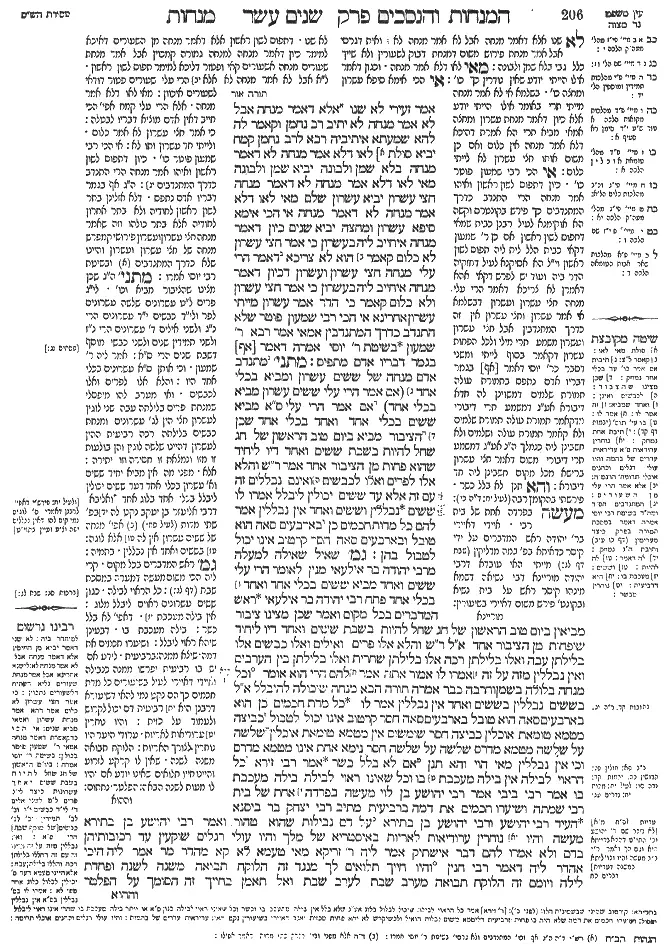
Menachot 103b - Guemara
אמר זעירי לא שנו אלא דאמר מנחה אבל לא אמר מנחה לא יתיב רב נחמן וקאמר לה להא שמעתא איתיביה רבא לרב נחמן קמח יביא סולת לאו דלא אמר מנחה לא דאמר מנחה בלא שמן ולבונה יביא שמן ולבונה מאי לאו דלא אמר מנחה לא דאמר מנחה חצי עשרון יביא עשרון שלם מאי לאו דלא אמר מנחה לא דאמר מנחה אי הכי אימא סיפא עשרון ומחצה יביא שנים כיון דאמר מנחה איחייב ליה בעשרון כי אמר חצי עשרון לא כלום קאמר הוא לא צריכא דאמר הרי עלי מנחה חצי עשרון ועשרון דכיון דאמר מנחה איחייב ליה בעשרון כי אמר חצי עשרון ולא כלום קאמר כי הדר אמר עשרון מייתי עשרון אחרינא אי הכי רבי שמעון פוטר שלא התנדב כדרך המתנדבין אמאי אמר רבא ר' שמעון בשיטת ר' יוסי אמרה דאמר [אף] בגמר דבריו אדם מתפיס:
מתני׳ מתנדב אדם מנחה של ששים עשרון ומביא בכלי אחד (אם אמר הרי עלי ששים עשרון מביא בכלי אחד) אם אמר הרי עלי שישים ואחד מביא ששים בכלי אחד ואחד בכלי אחד שכן הציבור מביא ביום טוב הראשון של חג שחל להיות בשבת ששים ואחד דיו ליחיד שהוא פחות מן הציבור אחד אמר ר' שמעון והלא אלו לפרים ואלו לכבשים ואינם נבללים זה עם זה אלא עד ששים יכולין ליבלל אמרו לו ששים נבללין וששים ואחד אין נבללין אמר להם כל מדות חכמים כן בארבעים סאה הוא טובל ובארבעים סאה חסר קרטוב אינו יכול לטבול בהן:
גמ׳ שאיל שאילה למעלה מרבי יהודה בר אילעאי מנין לאומר הרי עלי ששים ואחד מביא ששים בכלי אחד ואחד בכלי אחד פתח רבי יהודה בר אילעאי ראש המדברים בכל מקום ואמר שכן מצינו ציבור מביאין ביום טוב הראשון של חג שחל להיות בשבת ששים ואחד דיו ליחיד שיפחות מן הציבור אחד אמר לו ר' שמעון והלא אלו פרים ואילים ואלו כבשים אלו בלילתן עבה ואלו בלילתן רכה אלו בלילתן שחרית ואלו בלילתן בין הערבים ואין נבללין מזה על זה אמרו לו אמור אתה אמר להם הרי הוא אומר (ויקרא ז, י) וכל מנחה בלולה בשמן וחרבה כבר אמרה תורה הבא מנחה שיכולה להיבלל אמר לו בששים נבללין בששים ואחד אין נבללין אמר לו כל מדת חכמים כן הוא בארבעים סאה הוא טובל בארבעים סאה חסר קרטוב אינו יכול לטבול כביצה מטמא טומאת אוכלין כביצה חסר שומשום אין מטמא טומאת אוכלין שלשה על שלשה מטמא מדרס שלשה על שלשה חסר נימא אחת אינו מטמא מדרס וכי אין נבללין מאי הוי והא תנן אם לא בלל כשר אמר רבי זירא כל הראוי לבילה אין בילה מעכבת בו וכל שאינו ראוי לבילה בילה מעכבת בו אמר רבי ביבי אמר רבי יהושע בן לוי מעשה בפרדה אחת של בית רבי שמתה ושיערו חכמים את דמה ברביעית מתיב רבי יצחק בר ביסנא העיד רבי יהושע ורבי יהושע בן בתירא על דם נבילות שהוא טהור ואמר רבי יהושע בן בתירא מעשה והיו נוחרין ערודיאות לאריות באיסטריא של מלך והיו עולי רגלים שוקעין עד רכובותיהן בדם ולא אמרו להם דבר אישתיק אמר ליה ר' זריקא מאי טעמא לא קא מהדר מר אמר ליה היכי אהדר ליה דאמר רבי חנין (דברים כח, סו) והיו חייך תלואים לך מנגד זה הלוקח תבואה משנה לשנה ופחדת לילה ויומם זה הלוקח תבואה מערב שבת לערב שבת ואל תאמן בחייך זה הסומך על הפלטר
Comments from Rashi on Masechet Menachot Page 103b
לא שנו . דתפוס לשון ראשון אלא דאמר מנחה מן השעורים דאיכא למימר כיון דאמר מנחה למנחה גמורה קמכוין אבל אמר מנחת שעורים מנחה אשעורים קאי ופטור דליכא למימר תפוס לשון ראשון. ל"א אבל לא אמר מנחה לא אלא הרי עלי שעורים פטור דודאי לשעורים איכוון: מאי לאו דלא אמר מנחה . אלא הרי עלי קמח אפי' הכי חייב דאין אדם מוציא דבריו לבטלה: כי אמר חצי עשרון לא אמר כלום . ולייתי חד עשרון ותו לא: אי הכי רבי שמעון פוטר כו' . כיון דתפוס לשון ראשון ואיהו אמר מנחה הרי התנדב כדרך המתנדבים: ה"ג אף בגמר דבריו אדם נתפס . דלא אזלינן בתר לשון ראשון לחודיה ולא בתר אחרון לחודיה אלא בתר כולהו וזה שאמר מנחה חצי עשרון ועשרון פירושי קמפרש מנחה של חצי עשרון ועשרון והיינו שלא כדרך המתנדבים ובשיטת רבי יוסי אמרו: מתני' ה"ג שכן מצינו שהציבור מביא וכו' . לי"ג פרים ל"ט עשרונים שלשה עשרונים לפר ולי"ד כבשים י"ד עשרונים הרי נ"ג ולשני אילים ד' עשרונים הרי נ"ז ולשני תמידין שנים ולשני כבשי מוסף דשבת שנים הרי ס"א: אמר ליה ר' שמעון . וכי אותן ס"א עשרונים בכלי אחד היו: והלא אלו לפרים ואלו לכבשים . ואי מערב להו מיפסלי שמנחת פרים בלילתה עבה שני לוגין לעשרון חצי הין לג' עשרונים ומנחת כבשים בלילתה רכה רביעית ההין לעשרון דהיינו שלשה לוגין והן בולעות זו מזו ונמצאת זו חסירה וזו יתירה: אלא . מפני מה אין מביא יחיד ששים וא' עשרון בכלי אחד דעד ששים יכולין ליבלל בכלי אחד בלוג אחד ואליבא דרבי אליעזר בן יעקב נקט לה בפ' שתי מדות (לעיל מנחות פח.) אפי' מנחה של ששים עשרון אין לה אלא לוגה: בששים ואחד אין נבללין . בתמיה: גמ' ראש המדברים בכל מקום . קרי ליה הכי משום מעשה דמערה במסכת שבת (דף לג:): כל הראוי לבילה . כגון ששים עשרונים ראוים ליבלל מלוג: אין בילה מעכבת . דאפי' לא בלל כשר: בילה מעכבת בו . דבעינן שיהא ראוי ליבלל: ושיערו חכמים את דמה . שיצא ממנה: ברביעית . לידע אם יש בו רביעית יפרשו ממנה כנבילה ואיידי דאיירי לעיל בשיעורים כל מדת חכמים כך הם נקט נמי להאי דשיעורא דרבנן היא רביעית דם יכול לקרוש ולעמוד על כזית: והיו נוחרין ערודיאות לאריות . ערודי היער היו נוחרין לצורך האריות: הלוקח תבואה משנה לשנה . שאין לו קרקע לזרוע והיינו חייו תלואים שאינו יודע אם יהיו לו מעות לשנה הבאה: הפלטר . נחתום:
Comments from Tosafot - Menachot 103b
לא שנו אלא דאמר מנחה אבל לא אמר מנחה לא. ואית דגרסי אבל אמר מנחת פירוש משום דמנחת דבוק לשעורין ולא שייך כלל גבי בלא שמן ולבונה: מאי לאו דלא אמר מנחה. וכגון דאמר אילו הייתי יודע שאין נודרין כך כו': אי הכי אימא סיפא עשרון ומחצה כו'. בשלמא אי לא אמר מנחה מייתי תרי באומר אילו הייתי יודע אלא כיון דאמר מנחת עשרון ומחצה אמאי מביא תרי הא אמרת דהיכא דלא אמר מנחה אין כלום ואם כן משום אותו חצי עשרון לא לייתי כלום: אי הכי רבי שמעון פוטר כו'. כיון דתפוס לשון ראשון ואיהו אמר מנחה הרי התנדב כדרך המתנדבים כך פירש בקונטרס וקשה הא אוקימנא לעיל רבנן כבית שמאי דתפוס לשון ראשון אם כן ר' שמעון דקאי כבית הלל לית ליה תפוס לשון ראשון וי"ל הא אסיקנא לעיל דחזקיה הדר ביה ועוד יש לפרש דקאי אהא דאמרן לא צריכא דאמר הרי עלי מנחה חצי עשרון ועשרון דבשלמא אי אמר עשרון וחצי עשרון אין זה כדרך המתנדבין אבל חצי עשרון ועשרון משמע תרי מילי ולכל הפחות עשרון דקאמר בסוף לייתי ומשני דסבר כר' יוסי דאמר [אף] בגמר דבריו אדם נתפס בתמורת עולה תמורת שלמים דמשוינן לה חדא דיבורא אע"ג דמשמע תרי דיבורי מדקאמר תמורת עולה תמורת שלמים ולא קאמר תמורת עולה ושלמים ולא חשבינן ליה כנמלך ה"נ אע"ג דמשמע תרי דיבורי משום דאמר חצי עשרון ברישא מכל מקום חשבינן ליה חד דיבורא: והא תנן לא בלל כשר. פירשתי בהקומץ רבה (לעיל מנחות יח: ד"ה כי): מעשה בפרדה אחת של בית רבי. איידי דאיירי בר' יהודה ראש המדברים על ידי קיסר כדאיתא בפ' במה מדליקין (שבת דף לג:) מייתי האי עובדא דרבי יהודה מוריינא דבי נשיאה דשמא מינהו קיסר ראש על בית נשיא ובקונט' פירש משום דאיירי בשיעורין:
Menachot 103b - Mishnah translated into english
The Gemara cites another comment concerning the ruling in the mishna that a vow to bring a meal offering from barley takes effect: Ze’eiri said: The Sages taught that the first portion of one’s statement is accepted only where he said in his vow: Meal offering [minḥa], but not in the Hebrew construct where it is attached to the term: From barley [minḥat se’orim]. But if he did not say the word meal offering independently, but either said minḥat se’orim or said: It is incumbent upon me to bring barley, the vow does not take effect, and he does not bring a meal offering.
Rav Naḥman was sitting and reciting this halakha of Ze’eiri. Rava raised an objection to Rav Naḥman from the mishna: One who vows to bring a meal offering from regular flour, which is not used for a meal offering, should bring the meal offering from fine flour. Is it not referring to a case where he did not say: It is incumbent upon me to bring a meal offering, but rather said: It is incumbent upon me to bring regular flour? Apparently, the vow takes effect even if one did not state the term meal offering in an independent form. Rav Naḥman responded: No, it is referring to where he said: It is incumbent upon me to bring a meal offering of regular flour.
Rava raised another, similar objection from the continuation of the mishna: With regard to one who vows to bring a meal offering without oil and frankincense, his vow takes effect, and he shall bring it with oil and frankincense. What, is it not referring to a case where he did not say the word meal offering in his vow, and yet it still takes effect? Rav Naḥman responds: No, it is referring to a case where he said: It is incumbent upon me to bring a meal offering without oil or frankincense.
Rava asks again based on the mishna: If one vows to bring a meal offering of half a tenth of an ephah, he should bring a complete tenth of an ephah. What, is it not referring to a case where he did not say the term meal offering in his vow, and yet it still takes effect? Rav Naḥman responds: No, it is referring to a case where he said: It is incumbent upon me to bring a meal offering of half a tenth of an ephah.
Rava asks: If it is so that in all the cases in the mishna his vow included the term meal offering, say the last clause: If one vows to bring a meal offering of a tenth and a half of an ephah, he should bring two tenths. Once he said the term meal offering, he is obligated in bringing a tenth of an ephah of flour. Therefore, when he states the words: Half a tenth, he is not saying anything, as he did not say the term meal offering with it, and would not have to bring two tenths. In what case is the ruling in the latter clause relevant?
Rav Naḥman answers: No, it is necessary to teach the halakha in the case where he said: It is incumbent upon me to bring a meal offering of half a tenth and a tenth. Since he said the term meal offering, he is obligated in bringing a tenth of an ephah for it. When he said: Half a tenth, he is saying nothing, since a meal offering is not brought with that amount of flour. When he then said the word tenth, he therefore brings another tenth, totaling two tenths.
Rava asks: If so, then when the mishna continues: Rabbi Shimon deems one exempt from bringing a meal offering in all these cases, as he did not pledge in the manner of those who pledge, why is this his opinion? Once he said the term meal offering, the vow should be valid. Rava said in response: Rabbi Shimon stated his opinion according to the opinion of Rabbi Yosei, who said that the conclusion of a person’s statement is also accepted. Therefore, even when he said the term meal offering at the beginning of the vow, since at the end he also made declarations that do not apply to a voluntary meal offering, the vow does not take effect.
MISHNA: A person may pledge a meal offering of sixty tenths of an ephah of fine flour, and bring all sixty tenths in one vessel. If he says: It is incumbent upon me to bring sixty tenths of an ephah, he brings it in one vessel. If he says: It is incumbent upon me to bring sixty-one tenths of an ephah, he brings sixty tenths in one vessel and one tenth in another vessel, as the greatest number of tenths of an ephah that the community brings as meal offerings in one day is on the first festival day of Sukkot when it occurs on Shabbat, when sixty-one tenths of an ephah of fine flour are brought.
It is sufficient for an individual that the maximum amount he can bring at once is one tenth of an ephah less than that of the community. When the first day of Sukkot occurs on Shabbat, thirteen bulls, two goats, and fourteen lambs are sacrificed as the additional offerings of Sukkot, two lambs are sacrificed as the daily offerings, and two lambs are sacrificed as the additional offering of Shabbat. Three tenths of an ephah are brought for each bull, two tenths for each goat, and a tenth for each lamb. Altogether, that is sixty-one tenths of an ephah.
Rabbi Shimon says: What is the relevance of the tenths of an ephah sacrificed on Sukkot that occurs on Shabbat? Aren’t these meal offerings for bulls and those for lambs, and they are not mixed with each other (see 89a)? Rather, the reason that one may not bring more than sixty tenths of an ephah in one vessel is because up to sixty tenths of fine flour can be mixed with one log of oil.
The Rabbis said to him: Is it so that sixty tenths of flour can be mixed with a log of oil, but sixty-one tenths cannot be mixed? Rabbi Shimon said to them: All the measures of the Sages are so: For example, in a ritual bath containing forty se’a of water, one immerses for purification, and in a ritual bath with forty se’a less the small measure of a kortov, one cannot immerse in it for purification.
GEMARA: The Sages asked a question above, i.e., in front of, Rabbi Yehuda bar Elai: From where is it derived that one who says: It is incumbent upon me to bring a meal offering of sixty-one tenths, brings sixty tenths in one vessel and one tenth in another vessel?
Rabbi Yehuda bar Elai, the first speaker on every occasion, began his speech and said: Since we find that the greatest number of tenths of an ephah that the community brings in one day is on the first festival day of Sukkot when it occurs on Shabbat, when sixty-one tenths of fine flour are brought, it is therefore sufficient for an individual that the maximum amount he can bring at once is one tenth of an ephah less than that of the community.
Rabbi Shimon said to him: Aren’t these meal offerings brought with bulls and rams, and those brought with lambs? Don’t these, the meal offerings brought with the bulls, have a thick mixture, as six log of oil are mixed with three tenths of an ephah of flour, and those, the meal offerings brought with the lambs, have a thin mixture, as three log of oil are mixed with a tenth of an ephah of flour? Isn’t the mixture of these meal offerings, the daily offering and the additional offerings, performed in the morning, and the mixture of those meal offerings, brought with the afternoon daily offering, performed in the afternoon, and isn’t it the case that they are not mixed with one another? The communal offerings cannot serve as precedent because they never bring sixty-one tenths in one vessel.
The Sages said to him: You should state a reason why a meal offering of more than sixty tenths of an ephah must be brought in more than one vessel. Rabbi Shimon said to them: It says in the Torah: “And every meal offering, mixed with oil, or dry, shall all the sons of Aaron have, one as well as another” (Leviticus 7:10). The Torah has already stated here: Bring a meal offering that is capable of being mixed.
Rabbi Yehuda said to him: Is it so that if the mixture consists of sixty tenths of flour, it can be mixed with a log of oil, and if it consists of sixty-one tenths, it cannot be mixed? Rabbi Shimon said to Rabbi Yehuda: All the measures of the Sages are so: In a ritual bath containing forty se’a of water, one immerses for purification, and in a ritual bath with forty se’a less the small measure of a kortov, one cannot immerse and be purified.
Similarly, food in the volume of an egg-bulk transmits the ritual impurity of food, while food in the volume of an egg-bulk less a small amount equal to the volume of a sesame seed does not transmit impurity of food. Similarly, a garment that is three by three handbreadths is susceptible to ritual impurity imparted by treading if a man who experiences a gonorrhea-like discharge [zav] sits or lies on it, while if it is three by three handbreadths less one thread, a tiny measurement, it is not susceptible to ritual impurity imparted by treading.
The Gemara asks: Even if sixty tenths do not mix with one log of oil, what of it? But didn’t we learn in a mishna that although there is a mitzva to mix the oil with the flour in a meal offering, if he did not mix them, it is still valid? The Gemara answers that Rabbi Zeira says: For any measure of flour that is suitable for mixing with oil in a meal offering, the lack of mixing does not invalidate the meal offering. Although there is a mitzva to mix the oil and the flour ab initio, the meal offering is fit for sacrifice even if the oil and the flour are not mixed. And for any measure of flour that is not suitable for mixing with oil in a meal offering, the lack of mixing invalidates the meal offering.
The Gemara relates an incident involving halakhic measurements: Rabbi Beivai says that Rabbi Yehoshua ben Levi says: There was an incident involving a mule belonging to the house of Rabbi Yehuda HaNasi that died, and the Sages estimated the amount of its blood that emerged as a quarter-log, which is the minimum measurement for it to impart ritual impurity.
Rabbi Yitzḥak bar Bisna raises an objection: Rabbi Yehoshua and Rabbi Yehoshua ben Beteira testified that they had a tradition concerning the blood of unslaughtered animal carcasses that it is ritually pure. Similarly, Rabbi Yehoshua ben Beteira said: An incident occurred where people were killing wild donkeys in order to feed the meat to the lions that were in the king’s stadium [be’istarya], and those ascending to Jerusalem on the pilgrimage festival were wading up to their knees [rekhuboteihen] in the donkeys’ blood, and the Sages did not say anything to them about them becoming impure. Apparently, the blood of an animal carcass does not transmit ritual impurity, even though the carcass itself does.
Rabbi Beivai was silent and did not answer. Rabbi Zerika said to him: What is the reason that the Master does not respond to the question? Rabbi Beivai said to him: How can I respond to him? My circumstances can be described as Rabbi Ḥanin said in interpreting the verse: “And your life shall hang in doubt before you; and you shall fear night and day, and you shall have no assurance of your life” (Deuteronomy 28:66). “And your life shall hang in doubt before you”; this is referring to one who purchases grain from one year for the next, because he is not certain that he will find grain to eat in the next year.
“And you shall fear night and day”; this is referring to one who purchases grain from one Shabbat eve to another because he does not have the resources to provide for himself further. “And you shall have no assurance of your life”; this is referring to one who relies on the baker [hapalter] to give him bread because he has no grain of his own.
Traduction : The William Davidson digital edition of the Koren Noé Talmud, with commentary by Rabbi Adin Even-Israel Steinsaltz.
Menachot 103b : Significance
Next step
Finished studying Menachot 103b? Carry on with the rest of the tractate.
Study Menachot 104aFrequently asked questions: Menachot 103b
Where is Menachot 103b in tractate Menachot?
Menachot 103b is page 204 of 217 in tractate Menachot (Seder Kodashim).
When is daf 103 of Menachot studied in Daf Yomi?
Daf Yomi covers one daf a day, both sides. Daf 103 of Menachot will be studied on September 25, 2033.
Is there a video class on Menachot 103b?
Yes, by Daf Tube, Rabbi Dr. Moshe Weisblum. These classes were published on YouTube by their authors and are gathered on this site.
What is tractate Menachot about?
The Masechet Menahot is the second tractate of the Seder Kodashim. The Gemara Menahot is the study of the laws concerning the preparation and presentation of offerings of flour, grain, oil and drink. As well as the meal offering that was burnt on the altar and the rest that was to be consumed by the cohanim. The Menahot tractate has 13 chapters.
Your study is also dedicated to them
- L'ilui Nishmat Jacques Isaac Ben Amram Loubaton
- L'ilui Nishmat Margalit bat Ledicia
- L'ilui Nishmat Yechayahou ben Moche