 Talmud Bavli
Bava Batra 20b : Youtube
Daf TubeYoutube
2 video classes :
Bava Batra Page 20b
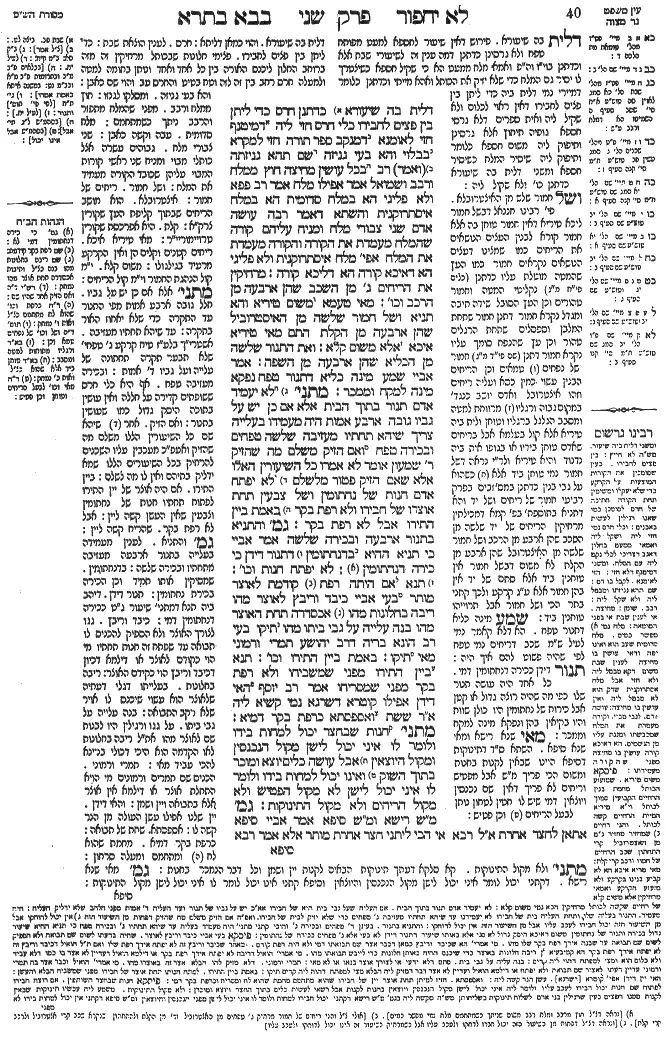
Bava Batra 20b - Guemara
דלית בה שיעורא כדתנן חרס כדי ליתן בין פצים לחבירו כלי חרס חזי ליה דמיטנף חזי לאומנא דמנקב ספר תורה חזי למקרא בבלוי והא בעי גניזה שם תהא גניזתה (ואמר) רב בכל עושין מחיצה חוץ ממלח ורבב ושמואל אמר אפילו מלח אמר רב פפא ולא פליגי הא במלח סדומית הא במלח איסתרוקנית והשתא דאמר רבה עושה אדם שני צבורי מלח ומניח עליהם קורה שהמלח מעמדת את הקורה והקורה מעמדת את המלח אפילו מלח איסתרוקנית ולא פליגי הא דאיכא קורה הא דליכא קורה:
מרחיקין את הריחים ג' מן השכב שהן ארבעה מן הרכב וכו':
מאי טעמא משום טיריא והא תניא ושל חמור שלשה מן האיסטרוביל שהן ארבעה מן הקלת התם מאי טיריא איכא אלא משום קלא:
ואת התנור שלשה מן הכליא שהן ארבעה מן השפה:
אמר אביי שמע מינה כליא דתנור טפח נפקא מינה למקח וממכר:
מתני' לא יעמיד אדם תנור בתוך הבית אלא אם כן יש על גביו גובה ארבע אמות היה מעמידו בעלייה צריך שיהא תחתיו מעזיבה שלשה טפחים ובכירה טפח ואם הזיק משלם מה שהזיק ר' שמעון אומר לא אמרו כל השיעורין האלו אלא שאם הזיק פטור מלשלם לא יפתח אדם חנות של נחתומין ושל צבעין תחת אוצרו של חבירו ולא רפת בקר באמת ביין התירו אבל לא רפת בקר:
גמ׳ והתניא בתנור ארבעה ובכירה שלשה אמר אביי כי תניא ההיא בדנחתומין דתנור דידן כי כירה דנחתומין:
לא יפתח חנות וכו':
תנא אם היתה רפת קודמת לאוצר מותר בעי אביי כיבד וריבץ לאוצר מהו ריבה בחלונות מהו אכסדרה תחת האוצר מהו בנה עלייה על גבי ביתו מהו תיקו בעי רב הונא בריה דרב יהושע תמרי ורמוני מאי תיקו:
באמת ביין התירו וכו'. תנא ביין התירו מפני שמשביחו ולא רפת בקר מפני שמסריחו אמר רב יוסף האי דידן אפילו קוטרא דשרגא נמי קשיא ליה א"ר ששת ואספסתא כרפת בקר דמיא:
מתני׳ חנות שבחצר יכול למחות בידו ולומר לו איני יכול לישן מקול הנכנסין ומקול היוצאין אבל עושה כלים יוצא ומוכר בתוך השוק ואינו יכול למחות בידו ולומר לו איני יכול לישן לא מקול הפטיש ולא מקול הריחים ולא מקול התינוקות:
גמ׳ מ"ש רישא ומ"ש סיפא אמר אביי סיפא אתאן לחצר אחרת א"ל רבא אי הכי ליתני חצר אחרת מותר אלא אמר רבא
Comments from Rashi on Masechet Bava Batra Page 20b
דלית בה שיעורא . והוי כמאן דליתא: חרס . לענין הוצאת שבת: כדי ליתן בין פצים לחבירו . פצימי חלונות שבכותל מרחיקין זה מזה ברוחב החלון ליכנס האורה בין כל אחד ואחד ונותן בחומה למטה ולמעלה חרס רחב בין זה לזה וטח בטיט והחרס עב והוי שם כאבן: והא בעי גניזה . ומסלקו לגנזו: חוץ ממלח ורבב . מפני שהמלח מתפזר והרבב ניתך כשמתחמם: מלח סדומית . עבה וקשה כאבן: שני צבורי מלח . גבוהים עשרה אצל כותלי מבוי ומניח שני ראשי קורות המבוי עליהן שכובד הקורה מעמיד את המלח: ושל חמור . ריחים של חמור: איצטרובלא . הוא מושב הריחים שבתוך קליפת העץ שקורין צרק"א: קלת . היא אפרכסת שקורין טרויימוריי"ר: מאי טיריא איכא . ריחים קטנים וקלים הן ואין הקרקע מרעיד בגילגולו: משום קלא . י"מ קול הנהגת החמור וי"מ קול הריחים: מתני' אלא אם כן יש על גביו . חלל גובה ארבע אמות מפי התנור עד התקרה כדי שלא יאחוז האור בתקרה: עד שיהא תחתיו מעזיבה . אשטרי"ך בלע"ז טיח קרקע ג' טפחי' שלא תבער תקרה תחתונה של עלייה ועל גביו ד' אמות: ובכירה מעזיבה טפח . אף היא כלי חרס ששופתים קדירה על חללה ואין עושין בתוכה היסק גדול כמו שעושין בתנור: ואם הזיק . אחר שיהא שם כל השיעורין הללו משלם מה שהזיק ואעפ"כ מעכבין עליו השכנים להרחיק בכל השיעורים הללו שמא ידליק בתיהם ואין לו מה לשלם: ביין התירו . אם היה אוצר של יין התירו לפתוח תחתיו חנות של נחתומין וצבעין שאין העשן קשה ליין: אבל לא רפת בקר . שהריח קשה ליין: גמ' והתניא . לענין מעמידה בעלייה בתנור ארבעה מעזיבה מתחתיו ובכירה שלשה: בדנחתומין . שמסיקין אותו תמיד וכן הכירה בכירת נחתומין: תנור דידן . דיהב ביה תנא דמתני' שיעור ג"ט ככירה דנחתומין דמי: כיבד וריבץ . גגו לצורך האוצר ולא הספיק להכניס לו תבואה עד שפתח זה חנות תחתיו מי הוי כקודם לאוצר או דילמא דכיון דכיבד וריבץ הוי כקידם האוצר: ריבה בחלונות . בעלייתו דגלי דעתיה שלאוצר הוא עשוי שיכנס לו אויר שלא ירקב התבואה: בנה עלייה על גבי ביתו . על גגו ורגילין היו לבנות שם לאוצר מהו את"ל ריבה בחלונות לאו הקדמה הוא היכי דכולי בניינא להכי עביד מאי: תמרי ורמוני . הכניס שם תמרים ורמונים מי הויא התחלת אוצר או דילמא אין אוצר אלא בתבואה ויין ושמן: והאי דידן . יין שלנו אפילו עשן העולה מן הנר קשה לו: אספסתא . שחת של תבואה: כרפת בקר דמיא . מחמת שהוא לח ומתחמם ומעלה סרחון: מתני' ולא מקול התינוקות . קא סלקא דעתך תינוקות הבאים לקנות יין ושמן וכל דבר הנמכר בחנות: גמ' מאי שנא רישא . דקתני יכול לומר איני יכול לישן מקול הנכנסין והיוצאין וסיפא קתני אינו יכול לומר לו איני יכול לישן מקול התינוקות:
Comments from Tosafot - Bava Batra 20b
דלית בה שיעורא. פירוש דאין שיעור לחספא למעט מפותח טפח ולא גרסינן כדתנן דמה ענין זה לשיעורי שבת אלא וכדתנן בוי"ו וה"פ ואמאי מלח ממעט הא כי שקיל חספא כשיצטרך לו יסיר גם המלח כדי שלא יזיק את הכותל ואהא מייתי וכדתנן כלומר דמיירי נמי דלית ביה כדי ליתן בין פצים לחבירו דאין ראוי לכלום ולא שקיל ליה ואית ספרים דלא גרסי חספא גופיה תיחוץ אלא גרסינן ותיפוק ליה משום חספא כלומר ותיפוק ליה שיסיר המלח כשיסיר חספא ומשני דלית בה שיעורא כדתנן כו' ולא שקיל ליה: ושל חמור שלש מן האיצטרובלא . פי' רבינו חננאל דבשל חמור ליכא טיריא דאין חמור טוחן בה אלא חמור קורא לבנין העצים הנושאים את הריחים כמו שמצינו דעצים הנושאים נקראים חמור כמו העץ שהמטה מוטלת עליו כדתנן (כלים פי"ח מ"ג) נקליטי המטה וחמור טהורים וכן העץ הסובל שידה תיבה ומגדל נקרא חמור דתנן חמור שתחת המלבן וספסלים שתחת הרגלים טהור וכן עץ שהנפח סומך עליו נקרא חמור דתנן (שם פי"ד מ"ג) חמור של נפחים טמאים וכן הריחים הבנין עשוי כמין כסא ועליה ריחים וזהו איצטרובל ואדם יושב כנגד' במקום גבוה ורגליו מרווחת למטה ומסבב הגלגל ברגליו וטוחן ולית ביה טיריא אלא קול בעלמא אבל בריחים שאדם טוחן בידיו או בגופו אית ביה נדנוד והיא טיריא ולר"י נראה דשל חמור נמי טוחן ביד אלא כשהוא על גבי בנין כדתנן במס' זבים בפרק רביעי חמור של ריחים ושל יד והא דתניא בתוספת' בפ' קמא דמכילתין מרחיקין הריחים של יד שלשה מן השכב שהן ארבע מן הרכב ושל חמור שלשה מן האיצטרובל שהן ארבע מן הקלת לא משום דבשל חמור אין טוחנין ביד אלא סתם של יד אין בהן חמור אלא ע"ג קרקע ולכך קתני בתר הכי ושל חמור אבל תרוייהו טוחנין ביד: שמע מינה כליא דתנור טפח. הא דלא קאמר נמי לעיל ש"מ שכב דריחים נמי טפח לפי שהיה פשוט להם איך היה: תנור דידן ככירה דנחתומין דמי. כל אחד היה עושה תנור שלו כפי מה שהיה רוצה גדול או קטן אבל כירות של נחתומין היו כולן שוות והיו בקיאין בהן ונפקא מינה למקח וממכר: מאי שנא רישא ומאי שנא סיפא. השתא ס"ד דתינוקות דסיפא היינו שבאין לקנות בחנות ומשום הכי פריך מ"ש אבל מפטיש וריחים לא פריך דאין שם נכנסין ויוצאין דמי שיש לו חטין לטחון נותן לבעל הריחים וכן פטיש:
Bava Batra 20b - Mishnah translated into english
The Gemara answers: This is referring to a case where the shard does not have the sufficient measure for ritual impurity, and is therefore considered insignificant. As we learned in a mishna (Shabbat 82a): One who carries a shard of earthenware on Shabbat is liable only if it is equivalent in size to that which is used to place between one pillar and another when they are piled on the ground, to strengthen the pillars.
The baraita teaches: An earthenware vessel reduces the dimensions of a window. The Gemara challenges: But it is fit for one to use; therefore, it is likely to be removed from the window. The Gemara answers: This is referring to a case where the earthenware is dirty. The Gemara challenges: Even so, it is fit for a bloodletter to collect the blood. It would not matter to him if the earthenware were dirty. The Gemara answers: It is referring to a case where it is perforated and therefore unfit for that use.
The baraita teaches: A Torah scroll reduces the dimensions of a window. The Gemara challenges: But it is fit for reading; therefore, it might be removed. The Gemara answers: This is referring to a Torah scroll that is worn out and unfit for reading. The Gemara challenges: But one is required to place the Torah scroll in a repository for unusable sacred books; therefore, he will certainly remove it to be stored away. The Gemara answers: This is referring to one who determines that its repository will be there. In other words, it was placed in the window with the intent of storing it there in its worn-out state.
§ With regard to the halakha of the baraita referring to salt, the Gemara cites that which Rav says: One can construct a barrier to delineate a private domain on Shabbat or to block the spreading of ritual impurity with anything except for salt and fat, as salt crumbles and fat melts in the heat. And Shmuel says: Even salt can be used as a barrier. Rav Pappa said: And they do not disagree, as this ruling of Shmuel is referring to Sodomite salt, which is like stone and can be used as a barrier, and that ruling of Rav is referring to isterokanit salt, which is taken from the sea and is composed of grains.
The Gemara adds: And now that Rabba said: If a person makes two piles of salt at the opening to an alleyway and places a cross beam on top of them, so that the salt supports the cross beam and the cross beam supports the salt by weighing it down and compressing it, he can use this beam to render it permitted to carry in the alleyway on Shabbat, one can say that even isterokanit salt can be used as a barrier. And even so, Rav and Shmuel do not disagree: This ruling of Shmuel is referring to a case where there is a cross beam to weigh the salt down, and that ruling of Rava is referring to a case where there is no cross beam.
§ The mishna teaches that one must distance a mill from a neighbor’s wall by a distance of three handbreadths from the lower stone of the mill, which is four handbreadths from the upper stone of the mill. The Gemara asks: What is the reason that one must distance a mill from the property of his neighbor? It is due to the vibrations it causes. The Gemara asks: But isn’t it taught in a baraita: And the measure for distancing a mill on a base is three handbreadths from the lower millstone [ha’isterobil], which is four handbreadths from the mouth [hakelet], where the wheat is fed in? But there, what vibrations are there? Rather, the reason for the distancing is due to the noise generated by the mill.
The mishna teaches: And there must be a distance of three handbreadths from the protruding base of an oven until the wall, which is four handbreadths from the narrow upper rim of the oven. Abaye said: Learn from the mishna that the base of an oven is a handbreadth wider than its rim. The practical difference of this observation is with respect to buying and selling, i.e., a buyer should know that this is the proper ratio for the dimensions of an oven.
MISHNA: A person may not set up an oven inside a house unless there is a space four cubits high above it, i.e., between the top of the oven and the ceiling, to avoid burning the ceiling, which serves as the floor of the residence above. If one was setting up an oven in the upper story, there must be a plaster floor beneath it, which serves as the ceiling of the lower story, at least three handbreadths thick, so that the ceiling below does not burn. And in the case of a stove the plaster floor must be at least one handbreadth thick.
And if he causes damage in any case, he pays compensation for that which he damaged. Rabbi Shimon says: They said all of these measurements to teach only that if he causes damage he is exempt from paying, as he took all reasonable precautions.
The mishna continues: A person may not open a bakery or a dye shop beneath the storeroom of another, and he may not establish a cattle barn there, as these produce heat, smoke, and odors, which rise and damage the items in the storeroom. The mishna comments: In truth, the halakha is that in the case of a storeroom of wine the Sages rendered it permitted to set up a bakery and a dye shop beneath, as the heat that rises does not damage the wine. But they did not render it permitted to establish a cattle barn, because its odor damages the wine.
GEMARA: The Gemara asks: But isn’t it taught in a baraita that in the case of an oven the plaster floor must be four handbreadths thick, and with regard to a stove it must be three? By contrast, the mishna says that the plaster floor beneath and oven and a stove must be three handbreadths and one handbreadth thick, respectively. Abaye said: When that baraita is taught it is with regard to ovens and stoves of bakers. Since they bake all day long, their implements get very hot. The oven discussed in our mishna is similar to a baker’s stove, which is why in both cases a distance of three handbreadths is required.
The mishna teaches that one may not open a bakery or a dye shop beneath the storeroom of another, and he may not establish a cattle barn there. A Sage taught: If the cattle barn preceded the storeroom it is permitted, i.e., the barn owner is not required to move it. With regard to this point, Abaye raises a dilemma: If he cleaned and sprinkled the area, i.e., he prepared it for use as a storeroom but he has not yet filled it, what is the halakha? Is it considered a storeroom already, and therefore others may no longer put a cattle barn beneath it, or perhaps the halakha is that as long as it is empty he cannot prevent others from establishing a cattle barn?
Similarly, if he added windows for ventilation, which demonstrates his intention to use it as a storeroom, what is the halakha? Likewise, if he establishes an enclosed veranda beneath the storeroom, what is the halakha? If he built an upper room on top of his house for storage, what is the halakha? None of these questions are answered, and the Gemara declares that they shall stand unresolved. The Gemara cites a similar question: Rav Huna, son of Rav Yehoshua, raises a dilemma: If he placed dates and pomegranates there, what is the halakha? Is this considered the start of its use as a storeroom or not? No answer was found to this question either, and the Gemara declares: The dilemma shall stand [teiku] unresolved.
§ The mishna teaches that in truth, it is permitted in the case of wine but not in the case of a cattle barn. The Gemara states that a Sage taught: They permitted it in the case of wine because the heat and the smoke improve the wine. But they did not permit one to establish a cattle barn, because a barn creates a bad odor. Rav Yosef said: This wine of ours spoils quickly, and therefore even the smoke of a candle also damages it. Rav Sheshet said: And alfalfa [ve’aspasta] is considered like a cattle barn in this regard, because it rots over time and creates a foul odor.
MISHNA: If a resident wants to open a store in his courtyard, his neighbor can protest to prevent him from doing so and say to him: I am unable to sleep due to the sound of people entering the store and the sound of people exiting. But one may fashion utensils in his house and go out and sell them in the market, despite the fact that he is not allowed to set up a store in the courtyard, and the neighbor cannot protest against him doing so and say to him: I am unable to sleep due to the sound of the hammer you use to fashion utensils, nor can he say: I cannot sleep due to the sound of the mill that you use to grind, nor can he say: I cannot sleep due to the sound of the children. It is permitted for one to make reasonable use of his own home.
GEMARA: The Gemara asks: What is different in the first clause of the mishna, which states that one can prevent his neighbor from opening a store in the courtyard because the noise keeps him awake, and what is different in the latter clause, which states that one cannot protest when his neighbor performs labor that is noisy? Abaye said: In the latter clause we arrive at the case of one who operates in another courtyard, i.e., one cannot prevent activity in a separate courtyard that is connected to the alleyway in which he lives. Rava said to him: If so, let it teach that in a different courtyard it is permitted. Why does the mishna not specify that it is referring to a different courtyard? Rather, Rava said:
Traduction : The William Davidson digital edition of the Koren Noé Talmud, with commentary by Rabbi Adin Even-Israel Steinsaltz.
Bava Batra 20b : Significance
Next step
Finished studying Bava Batra 20b? Carry on with the rest of the tractate.
Study Bava Batra 21aFrequently asked questions: Bava Batra 20b
Where is Bava Batra 20b in tractate Bava Batra?
Bava Batra 20b is page 38 of 350 in tractate Bava Batra (Seder Nezikin).
When is daf 20 of Bava Batra studied in Daf Yomi?
Daf Yomi covers one daf a day, both sides. Daf 20 of Bava Batra will be studied on December 17, 2031.
Is there a video class on Bava Batra 20b?
Yes, by Daf Tube, Rabbi Dr. Moshe Weisblum. These classes were published on YouTube by their authors and are gathered on this site.
What is tractate Bava Batra about?
Masechet Baba Batra is the third tractate of the Seder Nezikin. The Baba Batra gemara is the study of laws relating to matters relating to individual responsibility and the rights of property holders. The Baba Batra tractate is a gemara which contains 10 chapters.
Your study is also dedicated to them
- L'ilui Nishmat Avraham Ben Simha
- L'ilui Nishmat Yechayahou ben Moche
- L'ilui Nishmat אליעזר בן רחל