 Talmud Bavli
The learning on the whole site is dedicated : L'ilui Nishmat Jacques Isaac Ben Amram Loubaton
The learning on the whole site is dedicated : For the success of Elyahou ben H'anna & family
The learning on the whole site is dedicated : L'ilui Nishmat Yaakov ben Myriam
Sotah 49b : Youtube
Daf TubeYoutube
2 video classes :
Sotah Page 49b
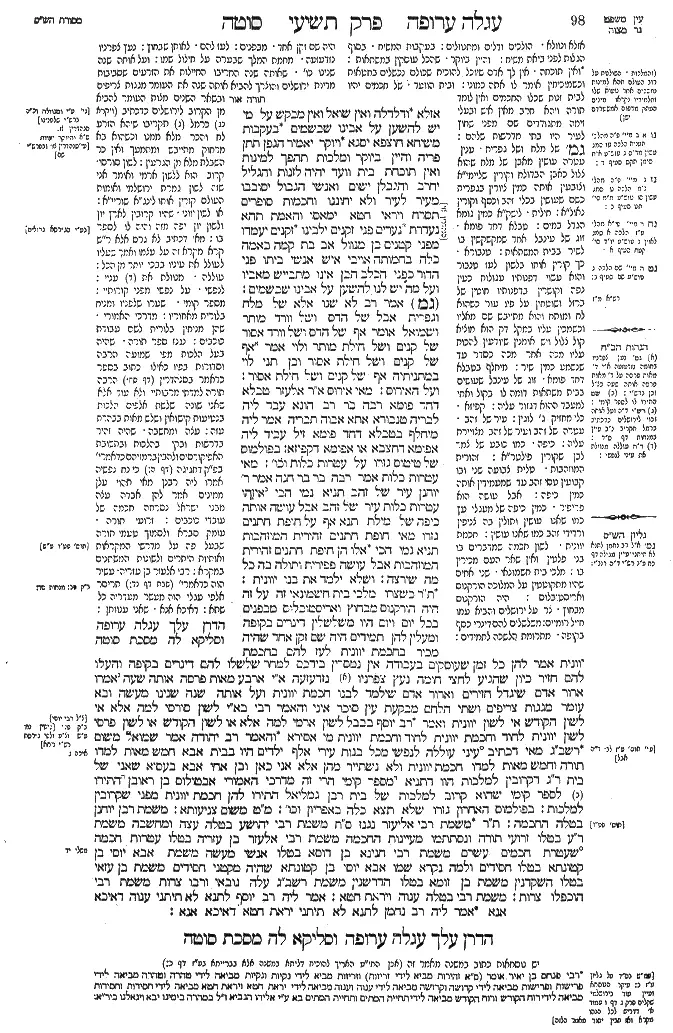
Sotah 49b - Guemara
אזלא ודלדלה ואין שואל ואין מבקש על מי יש להשען על אבינו שבשמים בעקבות משיחא חוצפא יסגא ויוקר יאמיר הגפן תתן פריה והיין ביוקר ומלכות תהפך למינות ואין תוכחת בית וועד יהיה לזנות והגליל יחרב והגבלן ישום ואנשי הגבול יסובבו מעיר לעיר ולא יחוננו וחכמות סופרים תסרח ויראי חטא ימאסו והאמת תהא נעדרת נערים פני זקנים ילבינו זקנים יעמדו מפני קטנים בן מנוול אב בת קמה באמה כלה בחמותה אויבי איש אנשי ביתו פני הדור כפני הכלב הבן אינו מתבייש מאביו ועל מה יש לנו להשען על אבינו שבשמים (גמ׳) אמר רב לא שנו אלא של מלח וגפרית אבל של הדס ושל וורד מותר ושמואל אומר אף של הדס ושל וורד אסור של קנים ושל חילת מותר ולוי אמר אף של קנים ושל חילת אסור וכן תני לוי במתניתיה אף של קנים ושל חילת אסור ועל האירוס מאי אירוס א"ר אלעזר טבלא דחד פומא רבה בר רב הונא עבד ליה לבריה טנבורא אתא אבוה תבריה אמר ליה מיחלף בטבלא דחד פומא זיל עביד ליה אפומא דחצבא או אפומא דקפיזא בפולמוס של טיטוס גזרו על עטרות כלות וכו' מאי עטרות כלות אמר רבה בר בר חנה אמר ר' יוחנן עיר של זהב תניא נמי הכי איזהו עטרות כלות עיר של זהב אבל עושה אותה כיפה של מילת תנא אף על חופת חתנים גזרו מאי חופת חתנים זהורית המוזהבות תניא נמי הכי אלו הן חופת חתנים זהורית המוזהבות אבל עושה פפירית ותולה בה כל מה שירצה ושלא ילמד את בנו יוונית ת"ר כשצרו מלכי בית חשמונאי זה על זה היה הורקנוס מבחוץ ואריסטובלוס מבפנים בכל יום ויום היו משלשלין דינרים בקופה ומעלין להן תמידים היה שם זקן אחד שהיה מכיר בחכמת יוונית לעז להם בחכמת יוונית אמר להן כל זמן שעוסקים בעבודה אין נמסרין בידכם למחר שלשלו להם דינרים בקופה והעלו להם חזיר כיון שהגיע לחצי חומה נעץ צפרניו נזדעזעה א"י ארבע מאות פרסה אותה שעה אמרו ארור אדם שיגדל חזירים וארור אדם שילמד לבנו חכמת יוונית ועל אותה שנה שנינו מעשה ובא עומר מגגות צריפים ושתי הלחם מבקעת עין סוכר איני והאמר רבי בא"י לשון סורסי למה אלא אי לשון הקודש אי לשון יוונית ואמר רב יוסף בבבל לשון ארמי למה אלא או לשון הקודש או לשון פרסי לשון יוונית לחוד וחכמת יוונית לחוד וחכמת יוונית מי אסירא והאמר רב יהודה אמר שמואל משום רשב"ג מאי דכתיב (איכה ג, נא) עיני עוללה לנפשי מכל בנות עירי אלף ילדים היו בבית אבא חמש מאות למדו תורה וחמש מאות למדו חכמת יוונית ולא נשתייר מהן אלא אני כאן ובן אחי אבא בעסיא שאני של בית ר"ג דקרובין למלכות הוו דתניא מספר קומי הרי זה מדרכי האמורי אבטולוס בן ראובן התירו לספר קומי שהוא קרוב למלכות של בית רבן גמליאל התירו להן חכמה יוונית מפני שקרובין למלכות בפולמוס האחרון גזרו שלא תצא כלה באפריון וכו' מ"ט משום צניעותא משמת רבן יוחנן בטלה החכמה ת"ר משמת רבי אליעזר נגנז ס"ת משמת רבי יהושע בטלה עצה ומחשבה משמת ר"ע בטלו זרועי תורה ונסתתמו מעיינות החכמה משמת רבי אלעזר בן עזריה בטלו עטרות חכמה (משלי יד, כד) שעטרת חכמים עשרם משמת רבי חנינא בן דוסא בטלו אנשי מעשה משמת אבא יוסי בן קטונתא בטלו חסידים ולמה נקרא שמו אבא יוסי בן קטונתא שהיה מקטני חסידים משמת בן עזאי בטלו השקדנין משמת בן זומא בטלו הדרשנין משמת רשב"ג עלה גובאי ורבו צרות משמת רבי הוכפלו צרות משמת רבי בטלה ענוה ויראת חטא אמר ליה רב יוסף לתנא לא תיתני ענוה דאיכא אנא אמר ליה רב נחמן לתנא לא תיתני יראת חטא דאיכא אנא
הדרן עלך ערופה וסליקא לן מסכת סוטה
Comments from Rashi on Masechet Sotah Page 49b
אזלא ונוולא . הולכים ודלים ומתנוולים: בעקבות המשיח . בסוף הגלות לפני ביאת משיח: והיין ביוקר . שהכל עוסקין במשתאות: ואין תוכחה . אין לך אדם שיוכל להוכיח שכולם נכשלים בחטאות וכשמוכיחין אומר לו אתה כמוני: ובית הוועד . של חכמים יהיו לבית זנות שכלו החכמים ואין לומד תורה ויהא חרב מאין איש ובעלי זימה מתגודדים שם מפני שחוץ לעיר היו בתי מדרשות שלהם: גמ' של מלח ושל גפרית . ענין עטרה עושין מאבן של מלח שהוא צלול כאבן הבדולח וקורין שליימי"א וצובעין אותה כמין ציורין בגפרית כשם שעושין בכלי זהב וכסף וקורין נאול"א: חילית . לישק"א כמין גומא הגדל במים: טבלא דחד פומא . זוג של עינבל אחד שמקשקשין בו לשיר בבית המשתאות: טנבורא . כך קורין אותו בלשון לעז טטנבור והוא עשוי דפנותיו עגולות כעין נפה וקושרין בדפנותיו חוטין של ברזל ושוטחין על פיו עור כשהוא לח ומותח והוא מתייבש שם מאליו וכשמכין עליו במקל דק הוא מוציא קול צלול ויש אומנין שיודעין להכות עליו מכה אחר מכה כסדר עד שנשמע כמין שיר: מיחלף בטבלא דחד פומא . זוג של עינבל שעושים בבית משתאות דומה לו בקול ואתי למעבד ההוא דגזור עליה: קפיזא . כלי מחזיק ג' לוגין: עיר של זהב . עטרה של זהב ועיר של זהב מצויירת עליה: כיפה . כמו כובע של צמר לבן שקורין פילטר"א (פילטרי"ן: כובע של לֶבֶד) : זהורית המוזהבות . טלית צבועה שני ובו קבועין טסי זהב עד שמעמידין אותה כמין כיפה: אבל עושה הוא פריפיר . כמין כיפה של מעגלי עץ כמו שאנו עושין ותולין בה צניפין ורדידי זהב כמו שאנו עושין: חכמת יוונית . לשון חכמה שמדברים בו בני פלטין ואין שאר העם מכירין בו: מלכי בית חשמונאי . שני אחים שהיו מתקוטטין על המלוכה הורקנוס ואריסטובלוס: היה הורקנוס מבחוץ . צר על ירושלים והביא עמו חייל רומיים: משלשלים להם דינרי כסף בקופה . מתרומת הלשכה לתמידים: היה שם זקן אחד . מבפנים: לעז להם . לאותן שבחוץ: נעץ צפרניו נזדעזעה . מחמת המלך שבערה על חילול שמו: ועל אותה שנה שנינו כו' . שאותה שנה החריבו החיילות את הזרעים שסביבות מדינת ירושלים והוצרך להביא אותה שנה את העומר מגגות צריפים ובשאר השנים מצות העומר להביא מן הקרוב לירושלים כדכתיב (ויקרא כג) כרמל תקריבו שיהא הזרע לח והכר מלא ממנו וכשהוא בא מרחוק מתייבש ומתמעך ואין כר השבלת מלא מן הגרעין: לשון סורסי . קרוב הוא ללשון ארמי ואומר אני שזה לשון גמרת ירושלמי ואומות העולם קורין אותו לינג"א שוריי"א (שפה סורית) : או לשון יווני . שהיו קרובין לארץ יון ולשון יון יפה מזה והיה לו לספר בו: מאי דכתיב לא גרס אלא ר"ש קרא מקרא זה על עצמו ואמר שעליו לעולל את עיניו בבכי יותר מן הכל: עוללה . מנוולת את עניי: לנפשי . על נפשי מפני קורותיי: מספר קומי . שערו שלפניו ומניח בלורית מאחוריו: מדרכי האמורי . שהן מניחין בלורית לשם עבודת כוכבים: נגנז ספר תורה . שהיה בעל הלכות מפי שמועה הרבה וסדורות בפיו כאילו כתוב בספר כדאמר בסנהדרין (דף סח.) הרבה תורה למדתי מרבותיי ולא עוד אלא שאני שונה שלשת אלפים הלכות בנטיעות קישואין ושלש מאות בבהרת עזה: עצה ומחשבה . שהיה זהיר בדרשות ובקי בהלכות ובתשובת האפיקורסים ולהבין ברמזיהם כדאמרי' בפ"ק דחגיגה (דף ה:) כי נח נפשיה אמרו ליה רבנן מאי תהוי עלן ממינים אמר להן אבדה עצה מבני ישראל נסרחה חכמה של עובדי כוכבים: זרועי תורה . עומק סברא ולסמוך טעמי תורה שבעל פה על מדרשי המקראות ואותיות היתרים ולשונות המשתנים במקרא: רבי אלעזר בן עזריה . עשיר הוה כדאמרי' (שבת דף נד:) תריסר אלפי עגלי הוה מעשר מעדריה כל שתא: דאיכא אנא . שאני ענוותן:
Sotah 49b - Mishnah translated into english
are increasingly diminished, and none ask and none seek. Upon whom is there to rely? Only upon our Father in Heaven.
He also said: In the times of the approach of the Messiah, impudence will increase and high costs will pile up. Although the vine shall bring forth its fruit, wine will nevertheless be expensive. And the monarchy shall turn to heresy, and there will be no one to give reproof about this. The meeting place of the Sages will become a place of promiscuity, and the Galilee shall be destroyed, and the Gavlan will be desolate, and the men of the border shall go round from city to city to seek charity, but they will find no mercy.
And the wisdom of scribes will putrefy, and people who fear sin will be held in disgust, and the truth will be absent. The youth will shame the face of elders, elders will stand before minors. Normal family relations will be ruined: A son will disgrace a father; a daughter will rise up against her mother, a daughter-in-law against her mother-in-law. A man’s enemies will be the members of his household. The face of the generation will be like the face of a dog; a son will no longer be ashamed before his father. And upon what is there for us to rely? Only upon our Father in heaven.
§ Rav says concerning the decree banning the wearing of crowns that they taught this halakha only with regard to crowns of salt and sulfur, but those of myrtle and rose are permitted. And Shmuel says that even crowns of myrtle and rose are prohibited, but those made of reeds and bulrush are permitted. And Levi says: Even crowns of reeds and bulrush are prohibited. And likewise Levi teaches in his baraita: Even those of reeds and bulrush are prohibited.
The mishna taught that the Sages decreed against the wearing of crowns for bridegrooms and upon the drums. The Gemara poses a question: What is this drum [irus]? Rabbi Elazar says: A drum with one mouth. The Gemara relates a story involving this instrument: Rabba bar Rav Huna made a tambourine for his son. His father, Rav Huna, came and broke it. He said to him: This instrument will be confused for a drum with one mouth, and people will assume that a drum with one mouth is permitted. Instead, go and make for him a small drum on the mouth of an earthen jug [ḥatzava], or on the mouth of a container used for measuring a kefiza, a small measurement, which did not pose the concern of being confused with a drum with one mouth.
They further taught that in the war of Titus the Sages decreed upon the crowns of brides. The Gemara clarifies: What are the crowns of brides? Rabba bar bar Ḥana says that Rabbi Yoḥanan says: A city of gold, a gold crown engraved with the design of a city, worn by women as an ornament. This is also taught in a baraita: Which are the crowns of brides that were forbidden? The crown of a bride is a city of gold. However, one may make it as a cap of fine wool [meilat].
The Sage taught: The Sages even decreed upon the canopy of grooms. The Gemara asks: What is the type of canopy of grooms that was prohibited, as they certainly did not ban the marriage canopy. The Gemara answers: It means the golden crimson [zehorit] clothes, dyed red and crimson and decorated with gold, which they would hang on a marriage canopy. This is also taught in a baraita: These are the canopy of grooms the Sages banned: The golden crimson clothes. But he may make a papyrus [papirit] construction and hang upon it whatever he wants, even ornaments made of gold.
§ The mishna taught that during the war of Titus the Sages decreed that a person should not teach his son Greek. The Sages taught that this decree came about as a result of the following incident: When the kings of the Hasmonean monarchy besieged each other in their civil war, Hyrcanus was outside of Jerusalem, besieging it, and Aristoblus was inside. On each and every day they would lower dinars in a box from inside the city, and those on the outside would send up animals for them to bring the daily offerings in the Temple.
A certain Elder was there, in Jerusalem, who was familiar with Greek wisdom. He communicated to those on the outside by means of Greek wisdom, using words understood only by those proficient in Greek wisdom. He said to them: As long as they are engaged in the Temple service, they will not be delivered into your hands. Upon hearing this, on the following day, when they lowered dinars in a box, they sent up a pig to them. Once the pig reached halfway up the wall, it inserted its hooves into the wall and Eretz Yisrael shuddered four hundred parasangs.
When the Sages saw this, they said at that time: Cursed is the person who raises pigs, and cursed is the person who teaches his son Greek wisdom. And with regard to that year of civil war, in which the land was destroyed, we learned (Menaḥot 64b): An incident occurred in which the omer, the measure of barley brought as a communal offering on the sixteenth of Nisan, came from Gaggot Tzerifim, and the two loaves offered on Shavuot came from the valley of Ein Sokher.
It is understood from both the mishna and the baraita that it is prohibited to learn Greek. The Gemara raises a question: Is that so? But didn’t Rabbi Yehuda HaNasi say: In Eretz Yisrael, why should people speak the tongue of Syriac [Sursi], the Aramaic commonly spoken in Eretz Yisrael? Rather, they should speak either in the sacred tongue, Hebrew, or in the beautiful tongue of Greek. And Rav Yosef similarly said: In Babylonia, why should they speak in the vernacular tongue of Aramaic? Rather, they should speak either in the sacred tongue, Hebrew, or in the tongue of Persian, used by the authorities.
The Gemara answers that there is a difference: The Greek tongue is discrete and Greek wisdom is discrete, and the Sages prohibited the latter but not the former.
The Gemara poses a question: And is Greek wisdom prohibited? But didn’t Rav Yehuda say that Shmuel said in the name of Rabban Shimon ben Gamliel: What is the meaning of that which is written: “My eye affected my soul, due to all the daughters of my city” (Lamentations 3:51)? There were a thousand children in my father’s house, the princes’ household. Five hundred of them learned Torah, and the other five hundred learned Greek wisdom, and there only remained of them, after the bar Kokheva revolt, me, here in Eretz Yisrael, and the son of my father’s brother, who lives in Asia Minor [Asya]. The fact that Rabban Gamliel allowed half of his household to study Greek wisdom indicates that it is permitted.
The Gemara answers: The members of the house of Rabban Gamliel are different, as they were close to the monarchy, and therefore had to learn Greek wisdom in order to converse with people of authority. As it is taught in a baraita (Tosefta, Shabbat 7:1): One who cuts his hair in the komi style, which was the gentile fashion of cutting and wearing the hair, is considered to be acting in the ways of the Amorites, and it is prohibited to act in their way. However, they permitted Avtolos ben Reuven to cut his hair in the komi style, as he is close to the monarchy, and similarly they permitted the house of Rabban Gamliel to study Greek wisdom, because they are close to the monarchy.
§ The mishna taught: In the last war the Sages decreed that a bride may not go out in a palanquin inside the city, but the later Sages permitted it. The Gemara explains: What is the reason they permitted this practice? Due to modesty, so that brides should not have to go out into the street and be seen by all.
The mishna taught that from the time when Rabban Yoḥanan ben Zakkai died, wisdom ceased. The Sages taught: From the time when Rabbi Eliezer died, it was as if the Torah scroll had been interred, as he had memorized many secrets of the Torah. From the time when Rabbi Yehoshua died, council and deliberate thought ceased, as he had the sharpest mind in Israel. From the time when Rabbi Akiva died, the powerful arm of Torah, meaning the exposition of all the details of Torah scripture, ceased, and the fountains of wisdom were sealed.
From the time when Rabbi Elazar ben Azarya died, the crowns of wisdom ceased, as “the crown of the wise is their riches” (Proverbs 14:24), and he was both a great Torah scholar and a very wealthy man. From the time when Rabbi Ḥanina ben Dosa died, the men of wondrous deeds ceased. From the time when Abba Yosei ben Katonta died, the pious men ceased. And why was he called Abba Yosei ben Katonta? Because he was among the diminished [miktanei] of the pious people, i.e., he lived in an era when the pious had become few.
From the time when ben Azzai died, the diligent ceased; from the time when ben Zoma died, the exegetists ceased. From the time when Rabban Shimon ben Gamliel died, locusts ascended upon the land and troubles proliferated. From the time when Rabbi Yehuda HaNasi died, the troubles multiplied.
The final line of the mishna states that from the time when Rabbi Yehuda HaNasi died, humility and fear of sin ceased. Rav Yosef said to the tanna who reviewed the mishna: Do not teach that humility ceased, for there is still one who is humble, namely me. Rav Naḥman similarly said to the tanna who reviewed the mishna: Do not teach that fear of sin ceased, for there is still one who fears sin, namely me.
Traduction : The William Davidson digital edition of the Koren Noé Talmud, with commentary by Rabbi Adin Even-Israel Steinsaltz.