 Talmud Bavli
Menachot 46b : Youtube
Daf TubeYoutube
2 video classes :
Menachot Page 46b
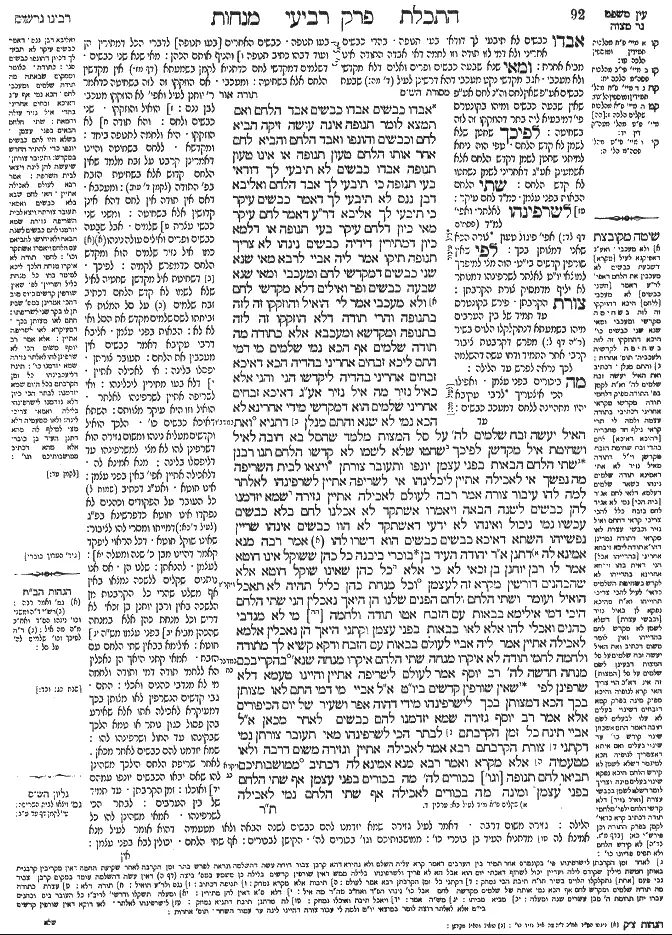
Menachot 46b - Guemara
אבדו כבשים אבדו כבשים אבד הלחם ואם תמצא לומר תנופה אינה עושה זיקה הביא לחם וכבשים והונפו ואבד הלחם והביא לחם אחר אותו הלחם טעון תנופה או אינו טעון תנופה אבדו כבשים לא תיבעי לך דודאי בעי תנופה כי תיבעי לך אבד הלחם ואליבא דבן ננס לא תיבעי לך דאמר כבשים עיקר כי תיבעי לך אליבא דר"ע דאמר לחם עיקר מאי כיון דלחם עיקר בעי תנופה או דלמא כיון דמתירין דידיה כבשים נינהו לא צריך תנופה תיקו אמר ליה אביי לרבא מאי שנא שני כבשים דמקדשי לחם ומעכבי ומאי שנא שבעה כבשים ופר ואילים דלא מקדשי לחם ולא מעכבי אמר לי' הואיל והוזקקו זה לזה בתנופה והרי תודה דלא הוזקקו זה לזה בתנופה ומקדשא ומעכבא אלא כתודה מה תודה שלמים אף הכא נמי שלמים מי דמי התם ליכא זבחים אחריני בהדיה הכא דאיכא זבחים אחריני בהדיה ליקדשו הני והני אלא כאיל נזיר מה איל נזיר אע"ג דאיכא זבחים אחריני שלמים הוא דמקדשי מידי אחרינא לא הכא נמי לא שנא והתם מנלן דתניא (במדבר ו, יז) ואת האיל יעשה זבח שלמים לה' על סל המצות מלמד שהסל בא חובה לאיל ושחיטת איל מקדשן לפיכך שחטו שלא לשמו לא קדשו הלחם תנו רבנן שתי הלחם הבאות בפני עצמן יונפו ותעובר צורתן ויצאו לבית השריפה מה נפשך אי לאכילה אתיין ליכלינהו אי לשריפה אתיין לשרפינהו לאלתר למה להו עיבור צורה אמר רבה לעולם לאכילה אתיין גזירה שמא יזדמנו להן כבשים לשנה הבאה ויאמרו אשתקד לא אכלנו לחם בלא כבשים עכשיו נמי ניכול ואינהו לא ידעי דאשתקד לא הוו כבשים אינהו שריין נפשייהו השתא דאיכא כבשים כבשים הוא דשרו להו אמר רבה מנא אמינא לה דתנן א"ר יהודה העיד בן בוכרי ביבנה כל כהן ששוקל אינו חוטא אמר לו רבן יוחנן בן זכאי לא כי אלא כל כהן שאינו שוקל חוטא אלא שהכהנים דורשין מקרא זה לעצמן (ויקרא ו, טז) וכל מנחת כהן כליל תהיה לא תאכל הואיל ועומר ושתי הלחם ולחם הפנים שלנו הן היאך נאכלין הני שתי הלחם היכי דמי אילימא בבאות עם הזבח אטו תודה ולחמה מי לא מנדבי כהנים ואכלי להו אלא לאו בבאות בפני עצמן וקתני היאך הן נאכלין אלמא לאכילה אתיין אמר ליה אביי לעולם בבאות עם הזבח ודקא קשיא לך מתודה ולחמה לחמי תודה לא איקרו מנחה שתי הלחם איקרו מנחה שנא' (במדבר כח, כו) בהקריבכם מנחה חדשה לה' רב יוסף אמר לעולם לשריפה אתיין והיינו טעמא דלא שרפינן לפי שאין שורפין קדשים ביו"ט א"ל אביי מי דמי התם לאו מצותן בכך הכא דמצותן בכך לישרפינהו מידי דהוה אפר ושעיר של יום הכיפורים אלא אמר רב יוסף גזירה שמא יזדמנו להם כבשים לאחר מכאן א"ל אביי תינח כל זמן הקרבתם לבתר הכי לשרפינהו מאי תעובר צורתן נמי דקתני צורת הקרבתם רבא אמר לאכילה אתיין וגזירה משום דרבה ולאו מטעמיה אלא מקרא ואמר רבא מנא אמינא לה דכתיב (ויקרא כג, יז) ממושבותיכם תביאו לחם תנופה [וגו'] בכורים לה' מה בכורים בפני עצמן אף שתי הלחם בפני עצמן ומינה מה בכורים לאכילה אף שתי הלחם נמי לאכילה
Comments from Rashi on Masechet Menachot Page 46b
בעו תנופה . כבשים האחרים [בעו תנופה] לדברי הכל דמתירין הן ועוד דבהו כתיב תנופה והניף אותם הכהן: מאי שנא שני כבשים . דשלמים דמקדשי לחם כדתניא לקמן בשמעתא (מנחות דף מז.) אין מקדשין הלחם אלא בשחיטה: ומעכבי . אם הוזקקו זה לזה בשחיטה כדאמר ר' יוחנן לעיל ואפי' לא הוזקקו מעכבי לבן ננס: הואיל והוזקקו . שני כבשים ולחם: והא תודה לא הוזקקו . היא ולחמה לתנופה ביחד: ומקדשא . ללחם בשחיטה והיינו דאמרינן קרבנו על זבח מלמד שאין הלחם קדוש אלא בשחיטת הזבח בפ' התודה (לקמן מנחות ד' עח:): ומעכבא . דאם אין תודה אין לחם דהא אינן קדושין אלא בשחיטה: ומשני שני כבשי עצרת שלמים . אבל שבעה כבשים ופרים ואילים עולה נינהו כמו איל נזיר שלמים הוא ומקדש הלחם כדמפרש לקמיה: לפיכך . דשחיטת איל מקדשן שחטיה לאיל שלא לשמו לא קדש הלחם דכתיב זבח שלמים על סל המצות אי זביחתו לשם שלמים מקדש את הסל ואי לא לא: הבאות בפני עצמן . אליבא דרבי עקיבא דאמר כבשים אין מעכבין את הלחם: תעובר צורתן . יפסלו בלינה: אי לאכילה אתיין . דלא בעו מתירין ליכלינהו: ואי לשריפה אתיין לשרפינהו לאלתר . הואיל וזו היא עיקר מצוותם: השתא דאיכא כבשים כו' . הלכך הואיל וקדשים מעליא נינהו ומשום גזירה הוא דשרפינן להו לא מצי למשרפינהו עד דליפסלו בלינה: מנא אמינא לה . דלאכילה אתיין אפי' באין בפני עצמן: אינו חוטא . ואע"ג דכתיב (שמות ל) כל העובר על הפקודים וכהנים לא נפקדו אינו חוטא כדפרשינא בפ"ג (לעיל מנחות ד' כא:) דמייתו ומסרי להו לציבור: שאינו שוקל חוטא . דכל הראוי ליפקד קאמר דהיינו מבן כ' שנה ומעלה: לעצמן . להנאתן: שלנו הן . אם אנו נותנים שקלים ללשכה נמצאו באין אף משלנו שהרי כל הקרבנות מן הלשכה באין ורבן יוחנן בן זכאי לא דריש וכל מנחת כהן אלא במנחה שהכהן מביא בפני עצמו מש"ה חוטא: אילימא בבאין שתי הלחם עם הזבח . אמאי קתני היאך הן נאכלין הא ללחמי תודה דמי ותודה ולחמה מי לא מנדבי כהנים ואכלי: התם . גבי קדשים הנשרפין לאו מצותן בכך דמעיקרא לאכילה אתו אלא שאירע בהן פסול כגון נותר או טמא הלכך שבקינהו עד החול ושרפינהו להו: שמא יזדמנו להם כבשים לאחר מכאן . לאחר שריפת הלחם הילכך משהינן להו שאם יבאו הכבשים יונפו עמהם ואוכלו: זמן הקרבתן . עד תמיד של בין הערבים: לבתר הכי לשרפינהו . אמאי משהינן להו כל הלילה: גזירה משום דרבה . דאמר לעיל גזירה שמא יזדמנו להם כבשים לשנה הבאה ולאו מטעמיה דהוא אומר לעיל מנא אמינא לה מדתניא העיד בן בוכרי כו': ממושבותיכם וגו' בכורים לה' . הקישן לבכורים: אף שתי הלחם . יכולין לבא בפני עצמן:
Comments from Tosafot - Menachot 46b
אבדו כבשים לא תיבעי לך דודאי בעי תנופה. בהדי כבשים אחריני ולא דמי לזו תודה וזו לחמה דאי אבדה התודה אינו מביא אחרת: ומאי שנא שבעה כבשים ופרים ואלים דלא מקדשי ולא מעכבי. אגב מקדשי נקט מעכבי דהא דרשינן לעיל (מנחות ד' מה:) שבעת כבשים אע"פ שאין לחם וה"נ לחם אע"פ שאין שבעה כבשים ומיהו בקונטרס פי' דמיבעיא ליה בתר דהוזקקו זה לזה בשחיטה: לפיכך שחטן שלא לשמן לא קדש הלחם. טפי הוה ניחא למיתני שחטן לשמן דקדש הלחם אלא אשמעינן אע"ג דאחריני לשמן נשחטו לא קדש הלחם: שתי הלחם הבאות בפני עצמן. כמ"ד לחם עיקר: לשרפינהו לאלתר. ואפי' למ"ד (פסחים דף לד:) אפי' פיגול טעון צורה הכא שאני דמצותן בכך: לפי שאין שורפין קדשים בי"ט. הוה מצי למיפרך למוצאי יו"ט לאלתר לשרפינהו דמנותר לא יליף מדמסיק צורת הקרבתן: צורת הקרבתן. פירש בקונטרס עד תמיד של בין הערבים מיהו בשמעתא דנתקלקלו הלוים בשיר (ר"ה דף ל:) מפרש דקרבנות ציבור קרבי אחר התמיד ודחו עשה דהשלמה לכך נראה לפרש עד הלילה: מה ביכורים בפני עצמן. ואפילו הכי איצטריך לרבי עקיבא יהיו מתהיינה ללחם דמעכב כבשים:
Menachot 46b - Mishnah translated into english
the sheep are lost as well, i.e., they cannot be sacrificed, and one must bring different loaves and sheep. Similarly, if the sheep are lost after the waving, the loaves are thereby lost as well, since a bond was established between them by means of the waving.
And if you say that waving does not establish a bond between the loaves and the sheep, then one can raise the following dilemma: If one brought loaves and sheep and they were waved, and then the loaves were lost and he brought other loaves to replace the original loaves, does that second set of loaves require waving with the sheep, as it has not yet been waved? Or does it not require waving, as the accompanying sheep have already been waved with the original loaves, and the sheep are the subject in the verse that serves as the source of the requirement of waving (see Leviticus 23:20)?
Rabbi Yirmeya clarifies the dilemma: In a case where the sheep were lost after the waving, do not raise the dilemma, as in this case they certainly require waving, because the primary obligation of waving is mentioned with respect to the sheep, and these sheep have not yet been waved. When should you raise the dilemma? You should raise it in a case where the loaves were lost after the waving.
And according to the opinion of Rabbi Shimon ben Nannas, who holds that failure to sacrifice the sheep prevents one from sacrificing the loaves, do not raise the dilemma, as he says that the sheep are primary. Consequently, since the sheep have been waved, there is no need to repeat the waving. When should you raise the dilemma? Raise it according to the opinion of Rabbi Akiva, who holds that failure to bring the loaves prevents one from sacrificing the sheep, as he says that the loaves are primary. According to his opinion, what is the halakha concerning the loaves that are brought as replacements?
On the one hand, one might say that since the loaves are primary and this set of loaves has not yet been waved, it requires waving. Or on the other hand, perhaps one should say that since its permitting factors are the sheep, and they were already waved, the new set of loaves does not require waving. The Gemara concludes that the question shall stand unresolved.
§ Abaye said to Rava: What is different about the two sheep brought as peace offerings together with the two loaves of Shavuot, such that their slaughter sanctifies the loaves (see 47a), and according to Rabbi Yoḥanan failure to sacrifice them once they have been slaughtered prevents the bringing of the loaves; and what is different about the seven sheep, the bull, and the two rams brought on Shavuot as an additional offering, such that their slaughter does not sanctify the loaves, and failure to sacrifice them does not prevent the bringing of the loaves?
Rava said to Abaye: The reason for the distinction is because the two sheep and the loaves brought as peace offerings are bound to each other through the waving. This is not so with regard to the additional offerings, which are not waved with the loaves. The Gemara challenges: But in the case of a thanks offering and its loaves, which are not waved together, they are not bound to each other through waving, and nevertheless the slaughter of the animal offering sanctifies the loaves and failure to sacrifice the animal offering prevents the bringing of the loaves. This indicates that the waving is not the critical factor.
Rather, the reason for the distinction is that the two sheep brought as peace offerings are comparable to a thanks offering. Just as a thanks offering is a peace offering, so too the two sheep are also a peace offering. Consequently, just as the slaughter of the thanks offering sanctifies the accompanying loaves, and failure to sacrifice the animal prevents one from bringing the loaves, the same applies with regard to the sheep peace offerings and loaves of Shavuot.
The Gemara responds: Are the two sheep of Shavuot and the thanks offering really comparable? There, in the case of the thanks offering, there are no other animal offerings brought with it. But here, in the case of the offerings brought on Shavuot, where there are other animal offerings brought with it, let these peace offerings and those additional offerings sanctify the loaves. Why is it only the sheep brought as peace offerings that sanctify the loaves?
Rather, the reason for the distinction is that the two sheep brought as peace offerings are comparable to a nazirite’s ram, which is sacrificed as a peace offering when he completes his term of naziriteship, in addition to a lamb that he sacrifices as a burnt offering, a female lamb that he brings then as a sin offering, and the nazirite loaves (see Numbers 6:14–15). Just as in the case of a nazirite’s ram, even though there are other offerings brought with it, nevertheless it is the slaughter of the peace offering that sanctifies the nazirite loaves and not the slaughter of anything else, here too, the halakha is no different, and it is specifically the slaughter of the peace offerings that sanctifies the loaves.
The Gemara asks: And there, in the case of the offerings of the nazirite, from where do we derive that it is specifically the slaughter of the peace offering that sanctifies the loaves? The Gemara answers: This is as it is taught in a baraita concerning a verse stated with regard to the offerings of the nazirite: “And he shall offer the ram for a sacrifice of peace offerings to the Lord, with the basket of unleavened bread” (Numbers 6:17). This verse, which connects the ram and the loaves, teaches that the basket of the nazirite loaves comes as an obligation for the ram, which is a peace offering, and the slaughter of the ram sanctifies the loaves. Therefore, if the slaughter was unfit, e.g., in a case where he slaughtered the ram not for the sake of a peace offering, the loaves were not sanctified.
§ The mishna teaches that according to Rabbi Akiva failure to sacrifice the two sheep brought as peace offerings does not prevent sacrifice of the loaves. Consequently, if there are no sheep, the loaves are sacrificed by themselves. Concerning this the Sages taught in a baraita: In a case where the two loaves are brought by themselves, they should be waved. They should then be left overnight so that their form decays, i.e., they become disqualified, and they are then brought out to the place of burning, like any disqualified offering.
The Gemara challenges: Whichever way you look at it, this is difficult: If the loaves are brought and waved in order to be eaten, let the priests eat them rather than burn them. If they are brought only to be burned, let the priests burn them immediately. Why are they left overnight so that they undergo a decay of form, i.e., become disqualified?
Rabba said: Actually, the loaves are brought and waved in order to be eaten. Nevertheless, the Sages instituted a rabbinic decree that they not be eaten out of concern lest sheep become available to the nation the following year, and they might say: Didn’t we eat the loaves without any accompanying sheep last year [eshtakad]? Now too, we will eat the loaves without sacrificing sheep.
And they will not know that the reason they were permitted to eat the loaves without sacrificing sheep last year is that there were no sheep, and therefore the two loaves permitted themselves to be eaten, i.e., they could be eaten without the sacrifice of the sheep. But now that there are sheep, it is the sacrifice of the sheep that permits the loaves to be eaten. Since loaves brought without sheep are fit by Torah law and may not be eaten due to rabbinic decree, they may not be burned until they become disqualified by remaining overnight.
Rabba said: From where do I say this, i.e., what is the source for my statement? It is as we learned in a mishna (Shekalim 1:4): Rabbi Yehuda said that ben Bukhri testified before the Sages in Yavne: Any priest who contributes his half-shekel is not considered a sinner, despite the fact that he is not obligated to do so.
Rabbi Yehuda added that Rabban Yoḥanan ben Zakkai said to ben Bukhri: That is not the case, rather, any priest who does not contribute his half-shekel is considered a sinner, as they are obligated in this mitzva like all other Jews. But the priests who do not contribute the half-shekel interpret this following verse to their own advantage in order to excuse themselves from the mitzva.
The verse states: “And every meal offering of the priest shall be wholly made to smoke; it shall not be eaten” (Leviticus 6:16). Those priests claim as follows: Since the omer offering and the two loaves, i.e., the public offering of two loaves from the new wheat, brought on the festival of Shavuot, and the shewbread placed on the Table in the Sanctuary each Shabbat, which are all meal offerings, are ours, then if we contribute half-shekels we will have partial ownership of these communal offerings, as they are purchased with the half-shekels. How, then, can they be eaten? They would then be regarded as priests’ meal offerings, which must be wholly burned.
Rabba discusses this mishna: What are the circumstances of these two loaves? If we say that the mishna is referring to a case where they are brought with the animal offering, i.e., the two sheep brought as peace offerings, why shouldn’t the loaves be eaten? Is that to say that priests cannot volunteer to bring a thanks offering and its loaves and eat them? Just as the loaves that accompany a thanks offering may be eaten, even if brought by a priest, the same halakha should apply to the two loaves when they accompany sheep brought as peace offerings.
Rather, is it not referring to a case where the two loaves are brought by themselves, and the mishna teaches that the priests claimed: How can they be eaten? Apparently, in principle the loaves come to be eaten, but due to rabbinic decree they are not eaten and are left overnight until their form decays.
Abaye said to Rabba in response: Actually, the mishna can be interpreted as referring to loaves brought with the animal offering, and therefore it does not prove that when the two loaves are brought by themselves they may be eaten. And as for that which is difficult for you based on the case of a thanks offering and its loaves, the resolution is that the loaves of a thanks offering are not called a meal offering, and therefore even when a priest brings a thanks offering, the loaves may be eaten. By contrast, the two loaves of Shavuot are called a meal offering, as it is stated with regard to the two loaves: “Also in the day of the first fruits, when you bring a new meal offering to the Lord” (Numbers 28:26). Therefore, the priests held that if they would donate half-shekels, the two loaves would not be permitted to be eaten.
Rav Yosef said a different response to Rabba’s proof: Actually, when the two loaves of Shavuot are brought by themselves they come to be burned, i.e., they may not be eaten. And this is the reason that we do not burn them until the following day: It is because one may not burn consecrated items on a Festival.
Abaye said to Rav Yosef: Is the burning of the two loaves comparable to the burning of other consecrated items, such that the loaves may not be burned right away for this reason? There, in the case of other consecrated items, this is not their mitzva, i.e., they are supposed to be eaten, but if they become disqualified they must be burned. Conversely, here, in the case of the two loaves of Shavuot that are brought by themselves, where this is their mitzva, i.e., they are supposed to be burned, let the priests burn them on the Festival, just as is the halakha in the case of the bull and the goat of Yom Kippur, which are burned on Yom Kippur despite the fact that it is a Festival.
Rather, Rav Yosef said: The reason the loaves are left overnight is due to a rabbinic decree not to burn them immediately, lest sheep become available to the nation afterward, i.e., later in the day, in which case the loaves could be waved with them and then eaten. Abaye said to Rav Yosef: That works out well for the entire time period when they may be sacrificed, i.e., until the afternoon daily offering is sacrificed. But after that, let them burn the loaves immediately and not wait until the next day. Rav Yosef replied: What is the meaning of the phrase in the baraita that teaches that the loaves must be left until their form decays? It means that they must be left until the form of their sacrifice has passed, i.e., until after the time when the sheep could be sacrificed.
Rava said that there is a different response to Rabba’s proof: When the two loaves of Shavuot are brought by themselves, by Torah law they come to be eaten, but due to rabbinic decree they are not eaten and are left overnight until they are disqualified. The reason for the decree is due to that which Rabba said, i.e., due to the concern that the following year sheep will be available and nevertheless the nation will bring the two loaves without sheep. But the proof that by Torah law the loaves may be eaten is not from Rabba’s line of reasoning, i.e., from the mishna in Shekalim; rather, it is from a verse.
And Rava said by way of explanation: From where do I state this halakha? From the fact that it is written with regard to the two loaves: “You shall bring out of your dwellings two loaves of waving of two tenth parts of an ephah; they shall be of fine flour, they shall be baked with leaven, for first fruits to the Lord” (Leviticus 23:17). Just as first fruits are brought by themselves, without an accompanying animal offering, so too the two loaves are brought by themselves when there are no sheep available. And learn from this comparison to first fruits that just as first fruits are brought to be eaten, so too the two loaves are also brought to be eaten, even in the absence of the sheep brought as peace offerings.
Traduction : The William Davidson digital edition of the Koren Noé Talmud, with commentary by Rabbi Adin Even-Israel Steinsaltz.